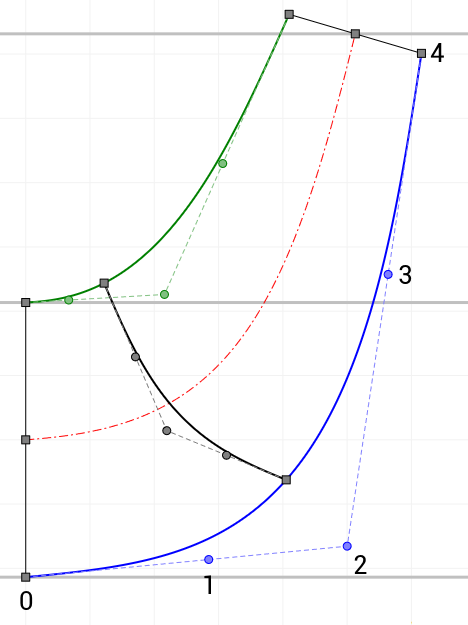
The contour is represented by 4th order Bezier curve. The curve is determined by five Bezier points.
|
Points 0 and 4 are defining the endpoints of the curves while the other three points determining the shape of the curve. The middle point (2) can be moved without any restrictions whereas points 1 and 3 have only one degree of freedom. Point 1 is only movable on the straight line between points 0 and 2, point 3 between point 2 and 4. Therefore no curvature is occurring at the end of the curves. In conjunction with a continuous curvature gradient small velocity gradients can be expected. The two straight lines are defining the gradients in the end points of the curves. |
|
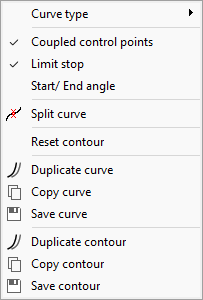
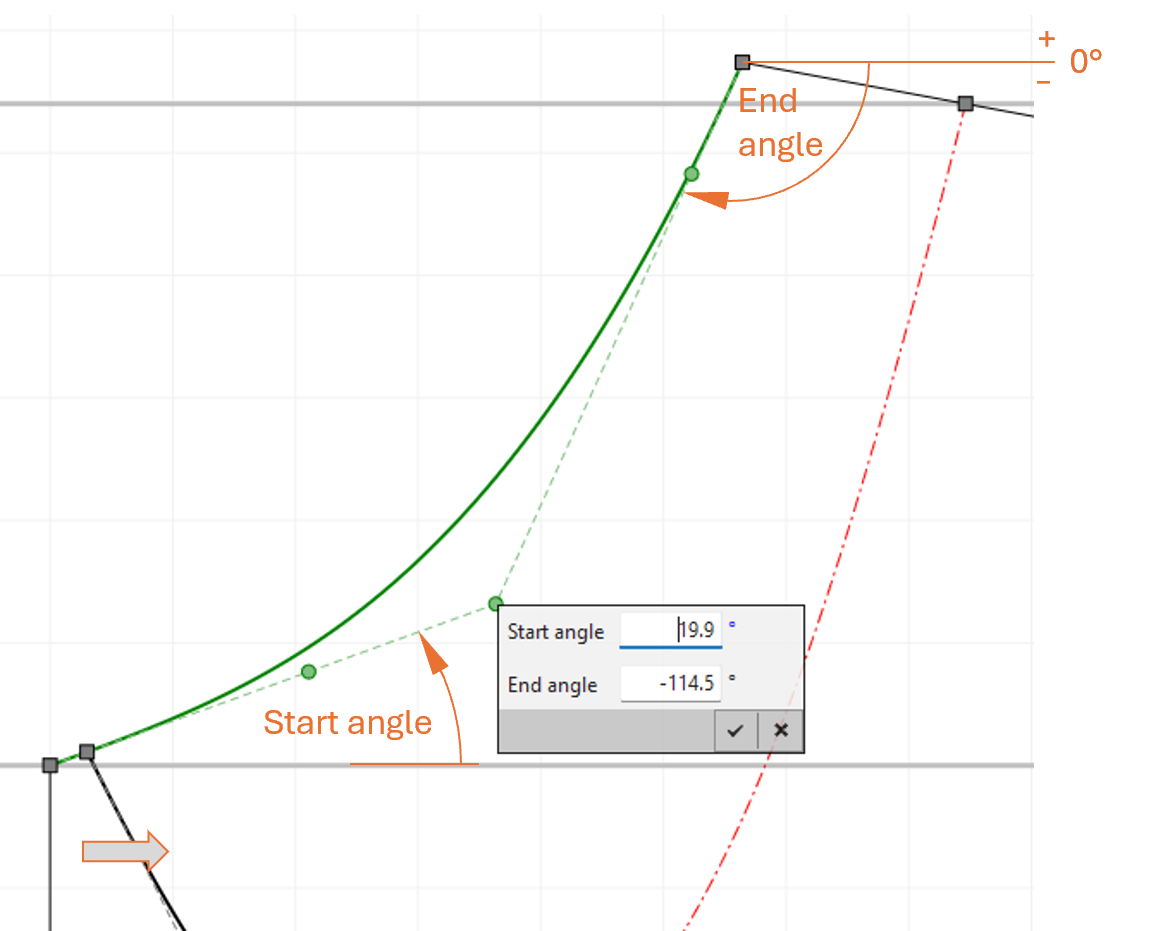
The above mentioned coupling between the Bezier points can be switched on or off by the curve context menu option Coupled control points. Bezier point 2 can be limited in its mobility by the curve context menu option Limit stop. As a result the axial and radial position is limited in the area between the curve endpoints 0 and 4. Start angle (line 0-1 or 0-1-2) and end angle (line 3-4 or 2-3-4) can be specified optionally by the curve context menu option Start/ End angle. If Coupled control points is not activated, the angle specification can be activated separately. |
Primary design
For an automatic primary design of the contours the following values are used:
▪Main dimensions: dH, dS, d2, b2
▪Inclination angle γ of trailing edge to horizontal (see Approximation functions)
▪Inclination angle ε of hub and shroud to vertical (see Approximation functions)
▪Axial extension: pumps, fans according to a) (Guelich), turbines according to b) (Lindner), compressor according to c) (Aungier). In some cases where the hub diameter dH is quite small compared to the impeller diameter d2, for compressors the average of a) and b) is applied instead of c).
a) |
|
b) |
|
c) |
|
Point 1 is primary placed at 75% of the axial distance of points 0 and 2, point 3 at 60% of the radial distance of points 2 and 4.