11.15.3 Simulation
This section explains the settings to run the Steady or the Transient simulations.
Steady simulation
- Select Steady in the Simulation Panel.
- Specify Number of Iterations as 500 and Result Saving Frequency as 500.
- Save the project file as "rotating_machinery_model_steady.spro" and click Start to run the simulation (see, Figure 11.349).
- The result files are saved as .sres in the working folder (Example: "rotating_machinery_model_steady.sres"). This file is overwritten depending on the Result Saving Frequency
The residuals for the Steady-state simulation are displayed under the Residual Tab in the Plot Panel (see, Figure 11.350).
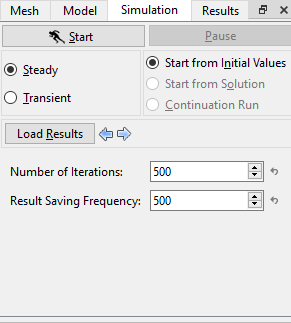
Figure 11.349 - Steady simulation settings
|
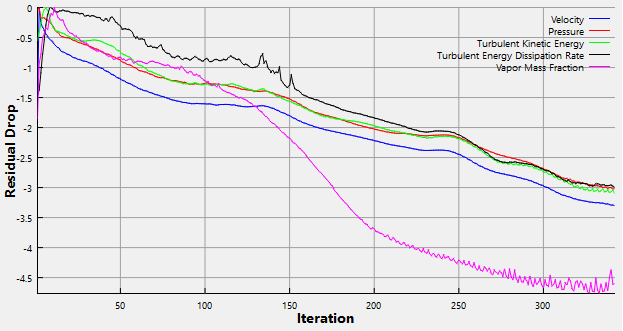
Figure 11.350 - Residual - Steady
|
| ´ |
Note: The default Converge Criterion is 0.001 for Steady-state simulations. A Steady-state simulation will run until the residual for each variable drops by 3 orders or until the maximum Number of Iterations is reached. |
Transient simulation
Rotor Volume Condition
In Transient Simulations, Volume Remesh approach is used to model impeller rotation.
Enter the parameters as follows:
- Select rotor from Volumes in the Geometric Entities Panel.
- Select Volume Remesh from the Volume Remesh drop-down list under Common in the Properties Panel.
-
Set Method to Rotation under Volume Remesh and enter the following.
- Rotational Direction: Counterclockwise
- Rotational Speed: 2950 rpm
- Rotational Center: 0, 0, 0 m
- Rotational Axis Vector: 0, 1, 0
- Ensure No is selected from the Noninertial Frame drop-down list under Flow in the Properties Panel.
|
|
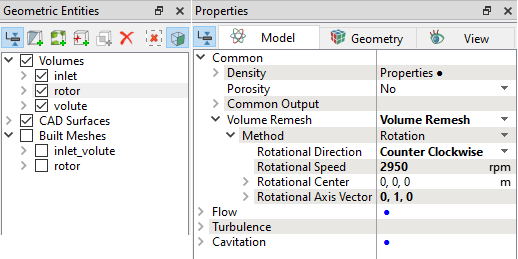
Figure 11.351 - Rotor Volume conditions
|

|
Note: Noninertial Frame must not be used in Transient simulation.
|
Time Definition
It is preferred to start the Transient simulation from a Steady State Simulation solution.
- Select Transient in the Simulation Panel.
- Specify the following:
- Simulation Time (Duration): 0.061016 s (time for 3 revolutions)
- Number of Time Steps: 360
- Number of Iterations: 25
- Result Saving Frequency: 120
Click Load Results and load the Steady State Simulation result file "rotating_machinery_model_steady.sres".
Ensure Start from Solution is selected and save the project as "rotating_machinery_model_transient.spro".
Click Start to run the simulation (see, Figure 11.352).
The result files are saved as .sres in the working folder (Example: "rotating_machinery_model_transient_0120.sres"). The number of result files depends on the Result Saving Frequency.
|
|
Note: The Result Saving Frequency option in the Simulation Panel is set to a small value (say 5 or 10) before running the simulation to obtain better animations. |
|
The residuals for the transient simulation are displayed under the Residual Tab in the Plot Panel as shown in Figure 11.353 .
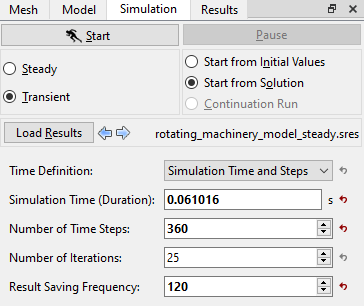
Figure 11.352 - Transient simulation settings
|
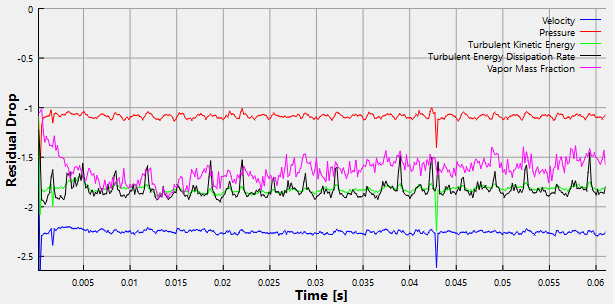
Figure 11.353 - Residual - Transient
|
|
|
Note: The default Converge Criterion is 0.1 for Transient simulations. When the residuals for all the variables drop by one order or the maximum Number of Iterations is reached, the calculation proceeds to the next time-step. |