6.6.1 Geometry and Domain
The simulation of the radial piston pump requires the understanding of the geometry and the fluid domain enclosed by the surfaces of the pump. The general fluid volume of the radial piston and prerequisite steps, before taking into Simerics-MP+ is described as follows:
Prerequisite steps
- In general, radial piston fluid volume consist of inlet port, outlet port, valve plate and piston cylinders.
- For pumping chamber, the template requires reference piston assembly and cam surfaces to be imported.
- If CAD geometry has leakage gap (In case of regular/arbitrary shape) then it should be split and the same should be imported.
Fluid Domain
This fluid domain in a radial piston pump is defined by CAD Surfaces which enclose them. The radial piston model primarily consists of the following parts/ volumes : Inlet, Outlet, Valve Plate, Piston Cam and Piston Cylinder as shown in Figure 6.353.
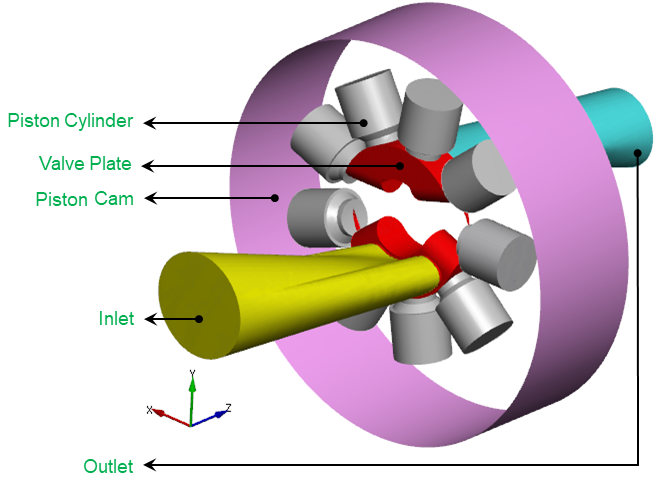
Inlet:The fluid enters the pump through the inlet boundary. Pressure is generally specified as a boundary condition at the inlet, while the other surfaces of the inlet volume are treated as walls.
Valve Plate:The fluid volume enclosed between inlet/outlet ports and cylinder.
Piston Cylinder:This is the pumping chamber, where fluid gets sucked and compressed.
Piston Cam: The compression/expansion of pistons is determined by this reference surface.
Outlet:The fluid exits the pump at the outlet boundary. Pressure is generally specified as a boundary condition at the outlet, while the other surfaces of the outlet volume are treated as walls.
For an example of the radial piston simulation, refer Radial Piston Tutorial.