中文 English

Defining Physics and Conditions

The physics and conditions are specified as follows.

Adding Modules
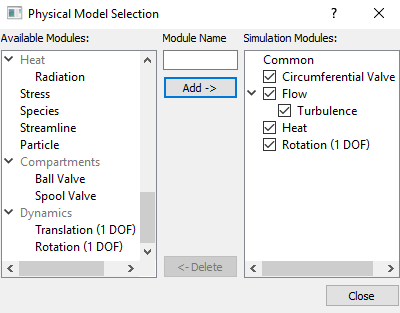
  1. Click Select Modules in the Model Panel. The Physical Model Selection dialog box opens.
  2. Circumferential Valve is automatically added to the Model Panel by the Valve Template Mesher.
  3. Select Turbulence, Heat and Rotation (1 DOF) under Available Modules and click Add.
  4. Click Close to close the Physical Model Selection dialog box.


Figure 6.581 - Adding modules

Circumferential Valve Operating Parameters
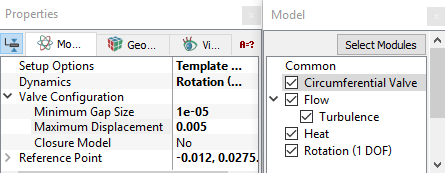
  1. Select Circumferential Valve in the Model Panel.
  2. Select Rotation (1 DOF) from the Dynamics drop-down list in the Model Tab of Properties Panel, to link the motion of the Circumferential Valve to the Rotation (1 DOF) module.
  3. Enter the parameters for the Valve Configuration as follows.

    • Minimum Gap Size: 1e-05

    • Maximum Displacement: 0.005


Figure 6.582 - Circumferential valve-Operating parameters


Note:

  • Closure Model determines whether the flow is fully blocked at the Minimum Gap Size.
  • The Minimum Gap Size specified in the Valve Template Mesher is larger than that for the actual model, so that the domain has a reasonable cell count.


Rotation 1 (DOF) Operating Parameters
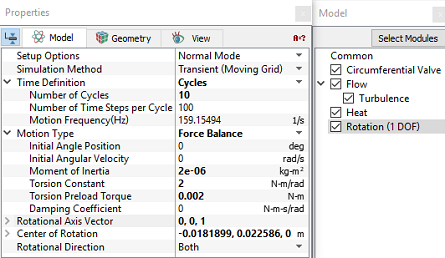
  1. Select Rotation (1 DOF) in the Model Panel.
  2. Enter the Time Definition parameters in the Model Tab of Properties Panel.

    • Number of Cycles10

    • Number of Time Steps per Cycle: 100

  3. Select Force Balance from the Motion Type drop-down list
  4. Enter the parameters for Motion Type as follows.

    • Moment of Inertia: 2e-06

    • Torsion Constant: 2

    • Torsion Preload Torque: 0.002
    • Rotational Axis Vector0, 0, 1
    • Center of Rotation-0.0181899, 0.022586, 0
´ Note:  Number of Time Steps per Cycle is an important parameter and needs to be large enough to achieve a smooth solution.
 

Figure 6.583 - Rotation 1 (DOF) - Operating parameters

Boundary Conditions

The boundary conditions are preset by the Valve Template Mesher and are specified as follows:

  1. Select the entities under Boundaries from the Geometric Entities Panel, as shown inTable 6.32.
  2. In the Model Tab of Properties Panel, verify the boundary type for the Circumferential Valve drop-down list, as shown in Table 6.32.
Boundaries Circumferential Boundary Type
valve_bot, valve_cylinder_in, valve_cylinder_out, and valve_top Cylinder
valve_end Valve End
valve_mgi_inlet Valve End
valve_valve Valve

Table 6.32 - Boundary type

Inlet
  1. Select inlet_inlet from the Boundaries list in the Geometric Entities Panel.
  2. Select Inlet from Circumferential Valve drop-down list in the Model Tab of Properties Panel.
  3. Click Edit Expression icon in the Inlet Pressure to open the Expression Editor dialog box .
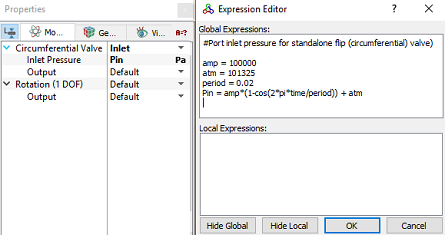
  4. Copy and paste the expressions written under Description drop-down list for Global Expressions, see Figure 6.584
  5. Click OK and enter Pin for the Inlet Pressure.
 

Figure 6.584 - Inlet conditions

Outlet
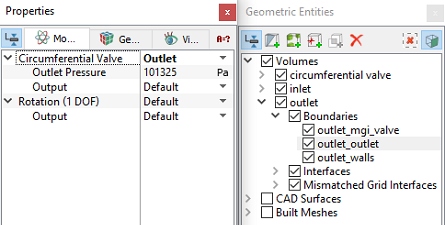
  1. Select outlet_outlet from the Boundaries list in the Geometric Entities Panel.
  2. Select Outlet from the Circumferential Valve drop-down list in the Model Tab of Properties Panel.
  3. Enter Outlet Pressure as 101325 Pa.
 

Figure 6.585 - Outlet conditions

Fluid Properties
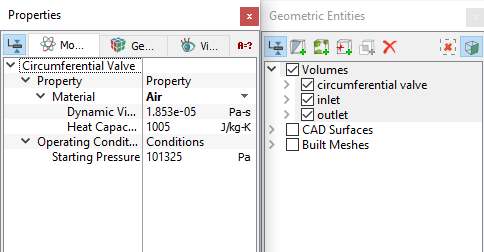
  1. Select Volumes in the Geometric Entities Panel.
  2. Select Model Tab in the Properties Panel.
  3. Enter the parameters for Property list as follows.
  • Material: Air
  • Dynamic Viscosity1.853e-05 Pa-s
  • Heat Capacity: 1005 J/kg-K
  • Enter the parameters for Operating Conditions as follows.

    • Starting Pressure: 101325 Pa
  •  

    Figure 6.586 - Fluid properties


    Copyright © 2023 Simerics Inc.,