6.4.1 Geometry and Domain
The simulation of the vane pump requires understanding of the geometry and the fluid domain enclosed by the surfaces of the pump. The general fluid volume of the vane pump and prerequisite steps, before taking into Simerics-MP+ is described as follows.
Prerequisite steps
The prerequisite steps are defined for the vane pumps based on their two different configurations: fixed vane pump and variable displacement vane pump.
Fixed vane pump
-
The fluid volumes for the fixed vane pump must be created such that the pumping chamber is separated from the inlet, outlet ports and from any other attached fluid volumes.
-
For the pumping chamber, the template requires the rotor and chamber wall surfaces to be imported.
-
The template creates leakage gaps based on the values provided. However, if the imported fluid volumes have different gaps than the actual, they should be adjusted by projecting the surfaces.
Variable Displacement Vane Pump (VDVP)
-
The fluid volumes for the variable displacement vane pump must be created such that the pumping chamber and sliders are separated from the inlet, outlet ports and from any other attached fluid volumes.
-
For vane chamber, the template requires the rotor and chamber wall surfaces to be imported.
-
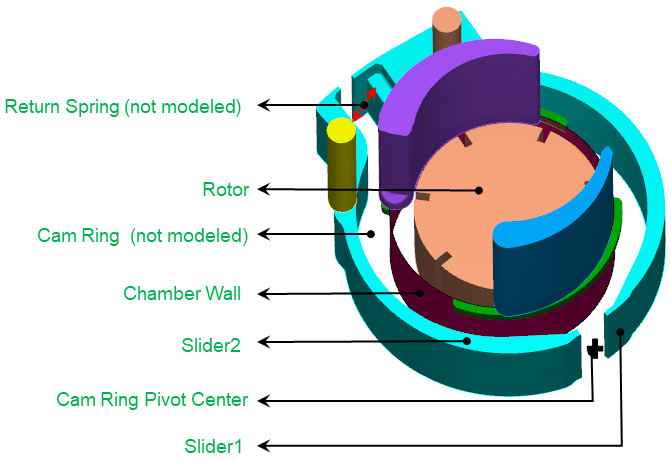
For sliders, the template requires cylindrical surfaces, valve surface and valve end surface to be imported.
-
Like in fixed vane pump, leakages are created using the template.
|
|
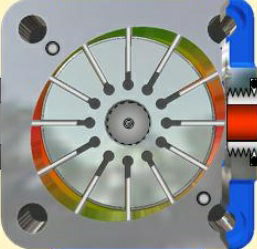
Figure 6.191 - Variable displacement vane pump |
|
Fluid Domain
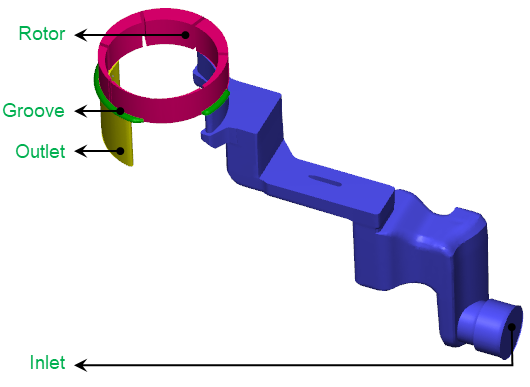
The fluid volume in a vane pump is defined by CAD Surfaces which enclose them. The vane model primarily consists of the following volumes : Inlet, Vane Chamber, Control Ports, Sliders (in case of VDVP) and Outlet, as shown in Figure 6.190.
Inlet: The fluid enters the pump through the inlet boundary. Pressure is generally specified as a boundary condition at the inlet, while the other surfaces of the inlet volume are treated as walls.
Vane Chamber: The fluid volume enclosed between the chamber and vanes. The fluid gets trapped and compressed in this volume.
Control Ports: In case of VDVP, these are feedback ports that control the position of the cam ring.
Sliders: Fluid volume enclosed between the cam ring and casing. These volumes rotate about pin center.
Outlet: The fluid exits the pump at the outlet boundary. Pressure is generally specified as a boundary condition at the outlet, while the other surfaces of the outlet volume are treated as walls.
|
Note: The vanes are not specified as separate fluid volumes in the Vane template. |
For an example of the vane pump simulation, refer Vane Pump Tutorial.