14.3 Convergence
The solution process in Simerics-MP is iterative. The user can limit the total number of Iterations (Global) for a Steady Simulation or total number of Iterations per time-step for a Transient Simulations by setting the Converge Criterion to the desired convergence tolerance.
Converge Criterion for the modules can be accessed as follows:
Model Panel > [Desired Module]
Properties Panel > Model Tab > Converge Criterion
When the correction for the module drops below its Converge Criterion, the code will stop (Steady) or move to the next time-step (Transient), assuming that the criteria for all other modules have been met as well.
Converge Criterion dictates the convergence criterion for solutions of variables. A smaller value of Converge Criterion implies more precision. The cost of a smaller value is more iterations, resulting in more computation time. In some cases, the added accuracy is not worth the additional expense. If the target Converge Criterion is too small, the solver may not be able to achieve it, in which case the solution will go the full Number of Iterations.
- The default Converge Criterion for Transient Simulations is 0.1 and for Steady Simulation is 0.001.
- The Residual Error Drop for each active variable is displayed in the Residual Panel (See Figure 14.15 for the residual graph).
- The scale for the Residual Drop is the exponent of the Residual, such that a drop of -3 corresponds to a Converge Criterionof 0.001.
These default values usually provide sufficient accuracy. More convergence is demanded for Steady Simulation because the initial guess is typically farther from the correct solution. In cases, where the solution is well converged, the residual may not drop. For example, for a Transient Simulations that has converged to a Steady solution, the solution at the beginning of each time-step is sufficiently accurate that the Residual Drop will remain nearly constant. In such cases, the user may want to use a larger (less stringent) Converge Criterion.
Residual calculation in Simerics
In an iterative solution, residuals are commonly used to measure solution convergence. The residuals are the imbalances of the physical quantities (such as, mass, momentum and energy) introduced by the inaccuracy of the current (numerical) solutions of the transport equations. After each iteration, Simerics solver first calculates the total residual by adding together the absolute values of the imbalance at each individual computational cell through the whole simulation domain. This is often called least absolute residual, or L1 residual. Then, the relative residual is calculated as the current total residual divided by the maximum total residual ever reached up to this iteration (within the same time step for a Transient Simulations). After that, the value of the relative residual is converted to a 10 based log scale. The final value is plotted in the residual plot. (See Figure 14.15)
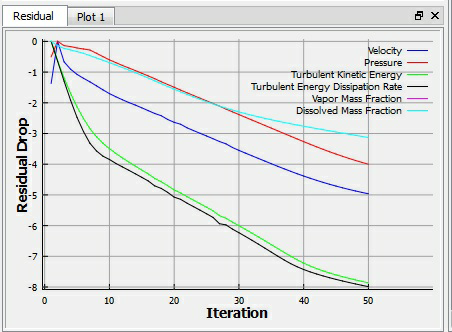
Table 14.9 - Convergence parameters
| Note:The Residuals for Velocity and Pressure are displayed in the *.out file as INFO(Sim02:Flow:V:CGS): Residual: 4.19235 Sweeps = 1 and INFO(Sim02:Flow:P:AMG): Residual: 52.4886 Sweeps = 2. |