


When TurboGrid initializes the ATM topology, it builds the topology in pieces and then conglomerates the block structure to minimize the number of blocks in the final topology. Because you can control only the number of elements along a given topology edge and not the distribution, having more blocks in specific areas, for example near the trailing edge, gives you better control of the mesh resolution in these areas. Preserving specific vertices from being conglomerated in these situations will give you better control of the local mesh resolution — the specific vertices will be dependent on the topology pieces used. For a list of the available topology pieces, see Advanced Topology Control.
You can retain additional vertices with CCL of the following format: "template name" , "vertex number". This must be repeated for each new vertex number, leading to the form:
TOPOLOGY SET:
  Override Conglomeration Retained Vertices List = true
  Conglomeration Retained Vertices List = "template name", "vertex number", "template name", "vertex number", ...
END
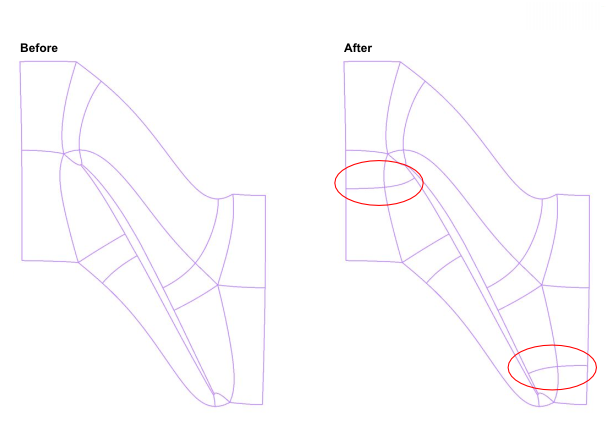
The following is an example of CCL that provides additional control near the leading and trailing edges for rounded blades:
TOPOLOGY SET:
  Override Conglomeration Retained Vertices List = true
  Conglomeration Retained Vertices List = LERoundedSymmetricStar, 0, TERoundedSymmetricStar, 0,\
  LERoundedSymmetricStar, 13, TERoundedSymmetricStar, 13
END
The figure below demonstrates the result of applying the example CCL.
You can apply edge splits using ATM Background Topology Edge
Refinement to influence the passage topology background mesh count.
One typical example is to apply edge splits on widely spaced blades. The following
CCL is used to apply eight edge splits on edges 8 and 10 of PassageBlock1by4:
TOPOLOGY SET:
  ATM Background Topology Edge Refinement = PassageBlock1by4, 8, 8, PassageBlock1by4, 10, 8
END
For cases where ATM Background Topology Edge Refinement
increases the passage topology background mesh count, the final mesh count at the
specified edges also goes up. You may want to add an edge split on those edges in
order to decrease the final mesh count in the blade-to-blade direction.