|
You are here: Fluid Machinery Templates and Tutorials > External Gear Pump > External Gear Pump Model > Operating Parameters
|
Operating Parameters
The operating parameters pertaining to the Gear template involve the time definition for the simulation, pump configuration, angular velocity definitions for pump rotation and other advanced/extended settings (see Figure 6.156).
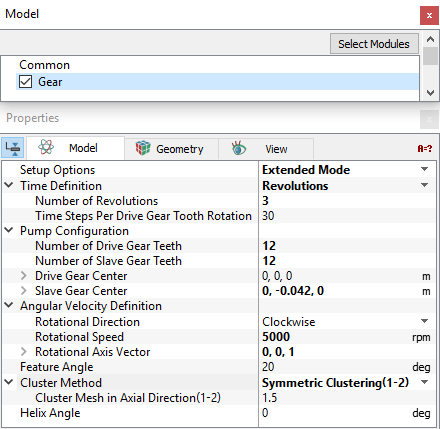
Figure 6.156 - Gear model-Operating parameters
Time Definition
This provides the following ways to specify the size and number of time steps for the external gear pump simulation (see Figure 6.156):
- Revolutions: A single revolution corresponds to a pump rotation of 360 degrees. The parameters required under this Time Definition are:
- Number of Revolutions: The number of pump revolutions to be simulated.
- Time Steps Per Drive Gear Tooth Rotation: The number of time steps taken to move the drive gear through one pocket (angle between the tips of two drive gear teeth).
The magnitude of the time-step size (s) and the angle of rotation (deg) depend on the Time Steps Per Drive Gear Tooth Rotation and the Number of Drive Gear Teeth as follows:

|
|

|
For a Time Definition of Revolutions, the Number of Time Steps is computed as follows:

|
- Number of Pockets: This dictates the amount of rotation based on the angle between two inner teeth.
- Time Steps Per Drive Gear Tooth Rotation
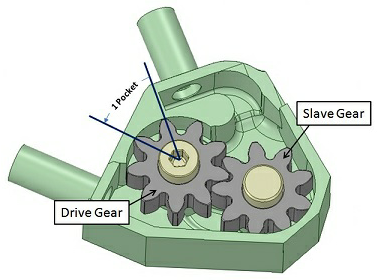
Figure 6.157 - Pocket-Gear
For a Time Definition of Pockets, the Number of Time Steps is computed as follows:

|
|
Note: The number of pockets corresponds to the number of inner teeth. |
- Time Steps Per Drive Gear Tooth Rotation
- Number of Time Steps (in the Simulation Panel)
For a Time Definition of Total Time Steps, the Simulation Time (Duration) is computed as follows:
 |
|
Note:
|
Pump Configuration
This contains parameters pertaining to the geometry of the external gear pump (see Figure 6.156). The inputs such as Number of Drive Gear Teeth, Number of Slave Gear Teeth, Drive Gear Center, Slave Gear Center and Feature Angle are same as those defined in the mesher.
Angular Velocity Definition
This contains parameters pertaining to the rotation of the pump. The parameters defined under the Angular Velocity Definition are: Rotational Direction, Rotational Speed and Rotational Axis Vector see Figure 6.143.
|
Note: A variable Rotational Speed can be specified using the Expression Editor. |
Cluster Method
This method controls the axial grid distribution in the drive and slave gears using the following methods:
- Linear Distribution gives a uniform cell spacing.
- Symmetric Clustering(1-2) stretches the mesh towards or away from the top and bottom of the drive and slave gears in the axial direction depending on the value entered for Cluster Mesh in Axial Direction(1-2). The original distribution gives a uniform cell spacing. The values entered must be between 1.0 and 2.0.
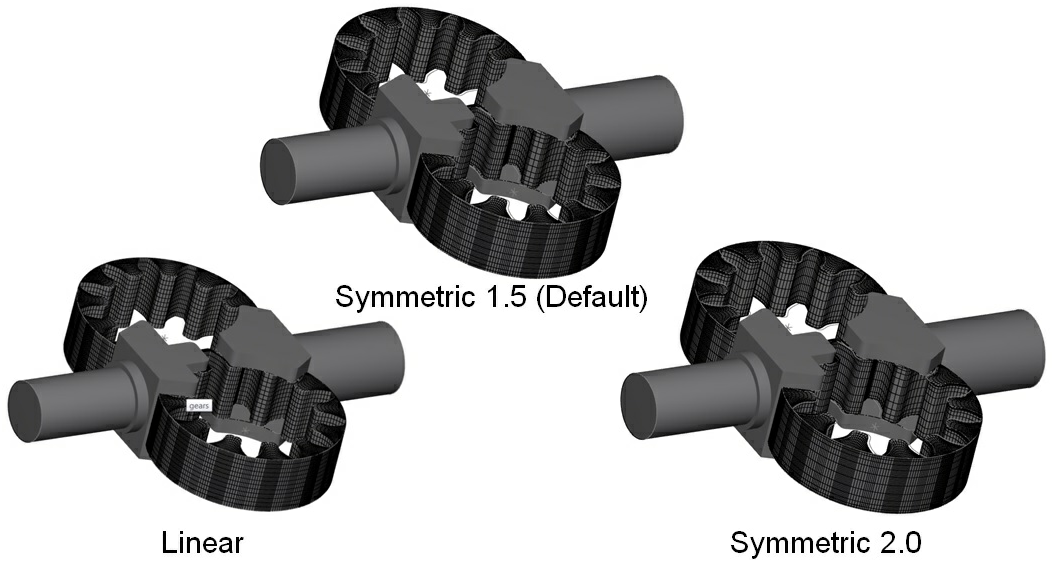
Figure 6.158 - Gear-Cluster method |
|
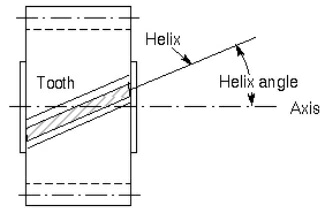
Helix Angle
This allows to specify the angle between the gear teeth axial inclination and the gear axis. During mesh generation, the Helix Angle (see, Figure 6.159) is used to specify the correct slant of the gear teeth whereas, the CAD Surfaces are used as bounds for the mesh to obtain a water-tight volume.