Special Considerations of VOF Model
VOF Model vs. Mixture Model
In the homogeneous Eulerian multiphase modelling approach, both the VOF and Mixture Eulerian models solve the same set of mixture (averaged) governing equations. However, they are based on different physical mechanisms and thus apply for different multiphase flow regimes:
The Mixture Model
The mixture model is designed for two or more phases (fluid or particulate), which are treated as interpenetrating continua. It solves for the mixture momentum equation and energy equations and the phase-to-phase interface is not tracked or no clear interfaces are observed. Applications of the mixture model include particle-laden flows with low loading, bubbly and droplet flows, sedimentation, and cyclone separators. The mixture model can also be used with prescribed relative velocities for the dispersed phases to model inhomogeneous multiphase flows.
The VOF Model
The VOF model is generally a transient surface-tracking technique designed for two or more immiscible fluids where the position of the phase-to-phase interface is of interest. In the VOF model, a single set of mixture momentum and energy equations (described in the previous section) is shared by all the phases and solved implicitly, while the phase volume fractions can be obtained using accurate explicit or implicit time algorithms with higher-order advection schemes in order to resolve sharp interfaces between a pair of phases. Typical applications of the VOF model include stratified flows, free-surface flows, filling, sloshing, the motion of large bubbles in a liquid, the motion of liquid after a dam break, the prediction of jet breakup (surface tension), and the tracking of any liquid-gas interfaces.
The VOF formulation relies on the fact that two or more fluids (or phases) are not interpenetrating. In any given control volume cell, therefore, the local phase volume fractions can alone determine whether it contains only one of the phases, or a mixture of phases. For instance, for the  phase, if the volume fraction in a cell is
  , then only the following three conditions are possible:
-
 : The cell is empty of the
  phase;
 -
 : The cell is full of the
  phase;
 -
 : The cell contains the interface between the
  phase and one/more other phase(s).
Therefore, the tracking of the interface(s) between the phases can be accomplished by the solution of a transport equation for the volume fraction of one (or more) of the phases.
The Effect of Surface Tension
Surface tension is the elastic tendency of a fluid surface which makes it acquire the least surface area possible. The typical example is an air bubble in a liquid. Within the bubble, the net force on a molecule due to its neighbors is zero. At liquid-air interfaces, the surface tension results from the greater attraction of liquid molecules to each other (due to cohesion) than to the molecules in the air (due to adhesion). The net effect is a radially inward force at its surface, which makes the bubble contract, thereby increasing the pressure inside the bubble to counterbalance the inter-molecular attractive force.
The Continuum Surface Force Model
In Simerics-MP, the VOF model can include the effects of surface tension along the interface between each pair of phases. The surface tension model adopted is based on the Continuum Surface Force (CFS) model of Brackbill et al1J. U. Brackbill, D. B. Kothe and C. Zemach,“A Continuum Method for Modelling Surface Tension”, Journal of Computational Physics, 100:335-354,1992.. This approach considers the surface tension effect as an additional volumetric force concentrated at the interface, rather than a surface force. For the free surface interface shown in Figure 5.98, the primary fluid is phase-  (the liquid phase), and the secondary fluid is phase-
 (usually a gas phase). According to the continuum surface force model, the surface curvature is computed from local gradients in the surface normal at the interface. Let
  be the surface normal vector, defined as the gradient of the primary fluid volume fraction,
  :
:

|
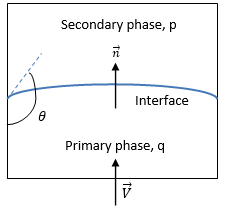
Figure 5.98 - Sketch of the free surface interface
The interface curvature  , is defined in terms of the divergence of the unit normal vector:

|
where  is the magnitude of the vector
  .
.
The surface tension force at the surface can be expressed as a volumetric force using the divergence theorem, which is an additional source term added to the mixture momentum equation. It has the following form:

|
where  is the surface tension coefficient between fluid-
 and fluid-
 . It has the unit of N/m.
The equation 5.289 allows for a smooth superposition of forces near cells where more than two phases are present. If only two phases are present in a cell, we have the relations:

|
where  is the mixture density. Then equation 5.289 can be reduced to:

|
Including the Surface Tension Force
The importance of surface tension effects is determined by two non-dimensional parameters: the Reynolds number  and the capillary number
  , or the Reynolds number and Weber number
  :
:
If  , the parameter of interest is the capillary number:

|
where  is the free-stream velocity. The surface tension effects can be neglected if
  , since the surface tension force is too small.
If  , the parameter of interest is the Weber number:

|
where  is the characteristic length. The surface tension effects can also be neglected if
  , when the inertial force is much larger than the surface tension force.
Wall Adhesion (Contact Angle)
In the VOF model, an option is available to specify a wall adhesion angle in conjunction with the surface tension model. According to Brackbill et al., instead of the application of this boundary condition at the wall directly, the contact angle between the fluid and wall at the interface is used to adjust the surface normal in cells near the wall. This so-called dynamic boundary condition results in the adjustment of the curvature of the surface near the wall.
If  is the contact angle of the free-surface interface at the wall, as shown in Figure 5.98, then the unit normal vector at the near-wall cell is calculated as:

|
where  and
and  are the unit vectors normal and tangential to the wall, respectively. Then the calculated unit normal velocity
  is used to determine the local curvature of the surface, equation 5.288, and subsequently the surface tension force, equation 5.289 or equation 5.290.