Particle Erosion Modeling
Erosion is a phenomenon that causes loss of material due to repeated impact of solid particles on a surface. Erosion is a major concern in many industries such as chemical, oil and gas, hydraulic transportation as it causes damage in pipes, valves and other flow passages. It is therefore important to study the erosion rate and find areas in the flow passages which are susceptible to erosion.
CFD-based erosion modeling includes three steps as follows:
- The flow field data such as velocity are obtained by solving the Navier- Stokes equations.
- Particles are released within the flow field and individually tracked to obtain information such as impact velocity and impact angle.
- The impact information of particles is used in an erosion equation to compute erosion ratio/rate or surface mass loss caused by the impacting particles.
Erosion equations study the effects of various parameters on erosion1Mazdak Parsi et al. “A comprehensive review of solid particle erosion modeling for oil and gas wells and pipelines applications” (2014) such as:
- Particle characteristics (size, shape, density, hardness, etc.)
- Particle impact information (particle impact velocity (
 ), impact angle (
 ), particle-particle interaction etc.)
 - Target wall properties (material density, hardness, etc.)
The erosion equations compute the erosion ratio ( ), defined as the amount of wall material loss (due to impact of solid particles) divided by the mass of the impacting solid particles.

|
5.548 |
Simerics-MP uses the following erosion models based on 2Mazdak Parsi etc. “CFD simulation of sand particle erosion in gas-dominant multiphase flow” (2015):
Finne model:
The erosion equation of Finne is as follows:

|
5.549 |

|
5.550 |
where

|
Wall material density (kg/m3) |

|
Particle impact velocity (m/s) |

|
Velocity exponent (equal to 2 for most industrial applications) |

|
Vicker hardness (Pa) |

|
Angle of impact (deg) |
Note: This model underestimates material removal for particle impact angles greater than  and no erosion is predicted for normal impacts. and no erosion is predicted for normal impacts. |
Zhang model:
The erosion equation of Zhang is as follows:

|
5.551 |
where

|
Erosion ratio |

|
 |

|
Brinell hardness of the wall material (Pa) |

|
Particle shape factor |

|
Particle impact velocity (m/s) |

|
Velocity exponent (equal to 2.41) |

|
Impact angle function |
The particle shape factor ( ) has a value of 1.0 for sharp (angular) sand particles. For semi-rounded and fully rounded sand particles (
 ) has values of 0.53 and 0.2 respectively.
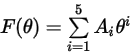
The impact angle function is given as follows:
|
5.552 |
Table 5.43 lists the values of  :
:


 in Zhang et. al(2007)
Oka model:
The erosion equation of Oka et al. is as follows:

|
|

|
|

|
|

|
|

|
where

|
Volumetric erosion rate (mm3/kg) |

|
Erosion damage at a normal impact angle (mm3/kg) |

|
Reference impact velocity (m/s) |

|
Particle diameter (m) |

|
Reference particle diameter (m) |

|
Vicker hardness (GPa) |
The values of different coefficients used in the equation 5.553, equation 5.554, equation 5.555, equation 5.556, and equation 5.557 can be seen in Table 5.44.


DNV model:
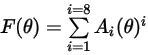
The erosion equation of DNV is as follows:

|
5.558 |
|
5.559 |
where  and
and  (velocity exponent) are
  and
and  , respectively. Table 5.45 lists the values of
  :
:


 in DNV model
Mansouri model:
Mansouri developed an erosion equation as follows:

|
|

|
where

|
Erosion ratio |

|
Brinell hardness of the wall material (Pa) |

|
Particle shape factor |

|
Particle impact velocity (m/s) |

|
Velocity exponent |

|
Impact angle function |

|
Vicker hardness (Pa) |

|
Angle of impact (deg) |
Table 5.46 highlights the values of different parameters used in equation 5.560 and equation 5.561 of Mansouri (2015) erosion equation.


Grant-Tabakoff model:
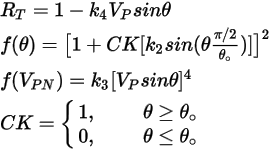
The erosion equation of Grant-Tabakoff is as follows:

|
where
|
5.563 |
where

|
Erosion ratio |

|
Particle impact velocity (m/s) |

|
Angle of impact (deg) |

|
Angle of maximum erosion (deg) |
Erosion rate ( ), in equation 5.562, is expressed as the amount (milligram) of material removed per unit of mass (gram) of impacting particles. The unit of velocity should be ft/s.
 is the angle of maximum erosion. For example,
  for aluminum based alloy.
The values of different coefficients for the Grant-Tabakoff model are given in Table 5.47 :


