5.10 Particle
Particle transport modelling belongs to the category of multiphase models that follow the Euler-Lagrange approach. Different from the Euler-Euler approach (Multiphase module) that considers all fluid phases as interpenetrating continua, the Euler-Lagrange multiphase model treats the dispersed fluid (particles, bubbles or droplets) as individual particles or a discrete phase through the continuous flow phase in a Lagrangian way. This type of multiphase model is commonly referred to as Discrete Phase (Particle) Model (DPM).
In the Euler-Lagrange approach, the fluid phase is treated as a continuum and is governed by the continuity and Navier-Stokes equations. For the discrete phase, it consists of a definite number of particles moving along or through the continuous fluid flow, and the volume of a particle is often assumed not to displace any fluid phase. A set of ordinary differential equations (ODE) in time, including equations for position, velocity, temperature and masses of species, are solved to track the trajectory of each individual particle as they traverse the flow domain. The particle-fluid interactions (the exchange of momentum, mass and energy) can be one-way or two-way coupling: the flow would always affect the particle motions, but the discrete phase may/ may not have significant counteracting influences on the continuous fluid phase depending on the characteristics of the discrete phase.
Clearly, to track each individual particle’s movement in time and space, the number of discrete phase equations solved is proportional to the number of particles involved. In addition, the particle-particle interactions such as collision, break-up and coalescence, can further complicate the tracking procedure and greatly increase the computational cost. For practical use, therefore, the discrete multiphase model usually contains the assumption that the second phase is sufficiently dilute so that particle-particle interactions and the effects of the particle volume fraction on the flow phase are negligible. Specifically, when choosing the Euler-Lagrange approach, the discrete phase must be present at a fairly low volume fraction, say, usually less than 10%. In other words, if the dispersed phase has a higher volume fraction, it is advised that such a dispersed phase should be considered as a continuous phase and the Euler-Euler multiphase models, described in Multiphase module, should be adopted.
In Particle module, the theory behind the Euler-Lagrange multiphase model and the particle erosion models are described. It consists of the model assumptions, particle motion theory, momentum transfer, particle-wall interaction, integration of the particle equations, flow-particle coupling and the parameters related to erosion due to particle impact on the wall. The model parameters and settings, the work flow and the post-processing quantities are also discussed in detail.
|
To activate the Particle module:
|
Figure 5.214 - Particle module |
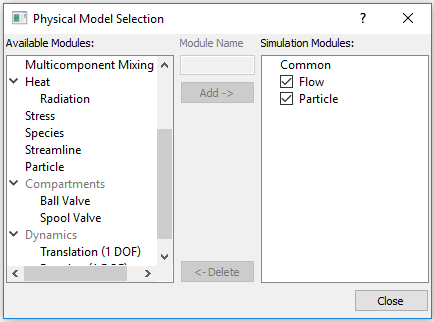
The module is explained as follows:
- Particle Physics: Overview and equations governing the Particle module.
- Particle Parameters: Parameters and methods used in the Particle module.
- Boundary Conditions: Specify conditions for the entities-boundaries, interfaces under the Particle module.
- Volume Conditions: Specify conditions for the volume, or a boundary under the Particle module.
- Output Variables: Outputs and post-processing associated with the Particle module.