Characteristics of Thermal Radiation
The characteristics of thermal radiation depend on the properties of the emitting object/body, including the surface temperature, surface smoothness/roughness, spectral absorptivity, and spectral emissive power. As electromagnetic waves, thermal radiation comprises a continuous dispersion of photon energies with a spectrum of frequencies/wavelengths. For an emitting body, the distribution of the spectrum, the peak value of the wavelength and the total radiated amount of all wavelengths vary with the surface temperature of the emitting body. In turn, at a given surface temperature, the absorptivity, reflectivity and emissivity of the emitting body are all dependent upon the wavelength of the radiation.
Interchange of Radiative Energy
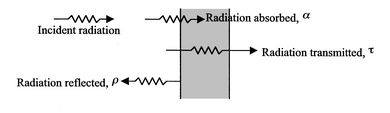
All bodies radiate energy in the form of photons moving in a random direction, with random phase and frequency. When radiated photons from the surface of one body reach the surface of another body, shown in Figure 5.166, they may be absorbed, reflected and/or transmitted. The behavior of a surface with radiation incident upon it can be described by the following quantities 1R. Siegel and J. R. Howell, “Thermal Radiation Heat Transfer”, Hemisphere Publishing Corporation, Washington DC, 1992.:
- Absorptance (
 ): The fraction of incident radiation absorbed at a given wavelength.
 - Reflectance (
 ): The fraction of incident radiation reflected at a given wavelength.
 - Transmittance (
 ): The fraction of incident radiation transmitted at a given wavelength.
The three coefficients are functions of the wavelength of the electromagnetic waves in radiation, . From the energy considerations, they must sum to unity:

|
According to the Kirchhoff’s law of thermal radiation, the emissivity of an emitting body is equal to the spectral absorptivity for any particular wavelength due to reciprocity:

|
where  is the emissivity, the ratio of the radiated energy from an emitting body to that from a perfect emitter (black-body) under the same temperature and wavelength.
equation 5.401 indicates that a body's behavior with regard to thermal radiation is characterized by its absorption ( ), reflection (
 ), and transmission (
 ). Depending on the values of
  ,
,  and
and  , the following idealized types of the emitting body are defined 2R. Siegel and J. R. Howell, “Thermal Radiation Heat Transfer”, Hemisphere Publishing Corporation, Washington DC, 1992.:
- Opaque Body: This type of body transmits none of the radiation that reaches it, although some may be reflected. That is
 and
and  .
. - Transparent Body: This type of body transmits all the radiation that reaches it. That is,
 and
and  .
. - Black-Body: Black-body, a theoretical model proposed by Planck, is an object that absorbs all incident electromagnetic radiation at all wavelengths, regardless of frequency or angle of incidence. If a radiation-emitting object meets the physical characteristics of a black-body in thermodynamic equilibrium, the radiation is called black-body radiation. For a black-body,
 , and
, and  .
. - White Body: This type of body is assumed to reflect all incident rays completely and uniformly in all directions. That is
 and
and  ;
; - Gray-Body: A gray-body is one where
 is uniform for all wavelengths. This term also is used to mean a body for which
  and
and  are temperature and wavelength independent. The radiation from a gray-body/surface is called gray radiation. Opposite to gray radiation, the thermal radiation with a spectrum of wavelengths is commonly referred to as non-gray radiation.
Radiative Power
To measure the amount of radiation, the following terminologies are of interest:
- Power
 : For a given source, the radiation power is the total/net radiative energy emitted, reflected, transmitted or received per unit time.
 - Irradiance (
 ): The radiation power received by a surface (
 ) per unit area,
  .
. - Emittance (
 ): The radiation power emitted (
 ) by a surface per unit area,
  .
. - Intensity (
 ): For a point source, the power radiated in a given direction (solid angle,
  ),
),  .
. - Radiance (
 ): The radiant power emitted, reflected, transmitted or received by a given surface,
per unit solid angle per unit projected area,
): The radiant power emitted, reflected, transmitted or received by a given surface,
per unit solid angle per unit projected area,  .
.
In theory, the Maxwell’s equations of electromagnetism can be used to build a theoretical description of the interaction of the radiative electromagnetic waves with matter. However, since it requires the precise knowledge of material properties, it becomes too complicated and uncertain to be applied for real bodies. To model thermal radiation, therefore, one still primarily relies on the theoretical models with empirical thermo-optical values to fit real behavior of materials.
Planck's Law:
Thermal radiation emitted by a body at any temperature consists of a wide range of frequencies. For a black-body, Planck's law describes the frequency distribution of the black-body radiation as only the function of the object’s temperature. Planck showed that the spectral radiance of a black-body,  , defined as the power emitted per unit area of the body, per unit solid angle that the radiation is measured over, and per unit frequency,
  , has the formulation respective to the body temperature:

|
where  is the Boltzmann constant,
  is the Planck constant, and
  is the speed of light in the medium (either vacuum or material).
The spectral radiance can also be expressed per unit wavelength,  :
:

|
Stefan-Boltzmann’s Law:
Through the integration of the Planck’s law over frequency,  , the power output given by Stefan-Boltzmann’s law is the power emitted from a black-body in terms of its temperature. The Stefan–Boltzmann’s law states that the total energy radiated per unit surface area of a black-body across all wavelengths per unit time. Specifically, the Stefan–Boltzmann’s law is also known as the black-body radiant emittance, is directly proportional to the fourth power of the black-body's thermodynamic temperature
  :
:

|
where  is the Stefan-Boltzmann constant and
  is radiant emittance.
For a gray-body, which does not absorb all incident radiation, emits less total energy than a black-body. With the introduction of the emissivity, (black-body:
  ), equation 5.405 is extended to a gray-body:

|
From the Stefan-Boltzmann’s law, the radiance and power emitted by a body are computed as:

|
|

|
Wien’s Displacement Law:
Wien’s displacement law states that the wavelength  , for which the spectral radiance of a black-body radiation per unit wavelength reaches its peak value, is inversely proportional to the temperature:

|
where  is Wien’s displacement constant.
Model Constants:
The model constants used in the above theoretical models are given in the following table:

|
Planck’s constant |
6.626 069 3(11) ×10-34J-s = 4.135 667 43(35) ×10-15eV-s |

|
Wien’s displacement constant | 2.897 768 5(51) ×10-3m-K |

|
Boltzmann constant | 1.380 650 5(24) ×10-23J/K = 8.617 343 (15) ×10-5eV/K |

|
Stefan-Boltzmann constant | 5.670 373 (21) ×10-8 W/(m2-K4) |

|
Speed of light | 299 792 458 m/s |
Table 5.33 - Radiation modelling Constants