5.7 Radiation
Thermal radiation is one of the three principal mechanisms of heat transfer: convection, conduction and radiation. It entails the emission of a spectrum of electromagnetic waves from all matter that has a temperature greater than absolute zero. In radiation, the energy is carried away from the emitting object by electromagnetic waves. Unlike the flow-driven heat convection and the conduction via direct physical contact, thermal radiation does not require the presence or participation of matter for the radiative heat to be transferred through a vacuum or any transparent medium (solid or fluid).
In a thermal system, radiation can be significant when the radiative heat flux is large compared to the heat transfer rate due to convection and/or conduction. Usually this occurs at high temperatures where the 4th-order dependence of the radiative heat flux on the body temperature implies that radiation would dominate the heat transfer process. Typical applications of radiation include the following:
-
Surface-to-surface radiant heating or cooling
-
Coupled heat transfer of radiation, convection, and/or conduction
-
Radiation through windows and cabin heat transfer
-
Radiation in glass processing, glass fiber drawing, and ceramic processing
-
Radiative heat transfer from flames
In CFD simulations, the goal of radiation modelling is to solve the radiative transport equation. Thus, the radiative source term for the governing equation of the total energy conservation and the radiative heat flux at the walls are obtained. In this chapter for the Radiation module, the fundamental theory of radiation and the radiation model employed in Simerics-MP are described. The model parameters and settings, the work flow and the post-processing quantities are also discussed in detail.
|
To activate the Radiation module:
|
Figure 5.165 - Radiation module |
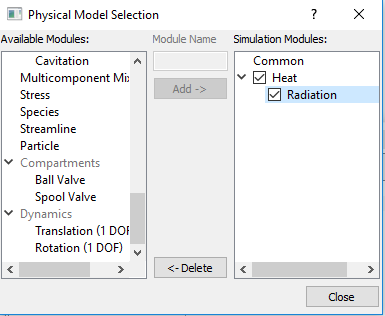
The module is explained as follows:
- Definitions: Terminologies used in radiation modelling.
- Physics: Models, methods and constants used in the Radiation module.
- Conditions: Specifying conditions for the entities-boundaries, interfaces, volumes under the Radiation module.