Turbulence Models
Ensemble Averaging and Boussinesq Hypothesis
The instantaneous (exact) continuity and Navier-Stokes equations, without the consideration of the external/user source and body forces, may be written in the following tensor form:
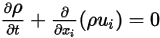
|
|

|
where

|
Instantaneous velocity component (m/s) |

|
Density (kg/m3) |

|
Pressure (Pa) |
In the RANS/URANS (Unsteady RANS) approach to model turbulent flows, the Reynolds-averaging (time-averaging) is employed to decompose instantaneous flow variables  in incompressible flows into time-averaged mean
  and fluctuating components
  as follows:
Velocity component:
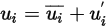
|
General scalar:

|
where  represents a passive scalar such as pressure, energy, species, and phase volume fractions (component) in multiphase flows.
For compressible flows, the Favre-averaging is adopted, and the two averaging methods have the relations:

|
|

|
where  and
and  are the Favre-averaged velocity component and passive scalar, respectively. Note that density is always time-averaged.
Substituting the above expressions into the instantaneous equations equation 5.83 and equation 5.84 and taking an ensemble average, we have the RANS/URANS governing equations (using  to denote the averaged velocity component and dropping the overbar on the other averaged variables):
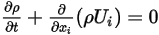
|
|

|
equation 5.90 shows that averaging the Navier-Stokes equations results in an unknown term,  , in the momentum conservation equation. It is commonly referred to as “Reynolds stress”, and appropriate “turbulence model” is required to close the averaged flow governing equations.
Without directly solving transport equations for each component of the Reynolds stress tensor (Reynolds Stress Models, RSM), the Boussinesq hypothesis is commonly used to relate the Reynolds stresses to the mean velocity field1J. O. Hinze, “Turbulence”. McGraw-Hill Publishing Co., New York. 1975. :

|
where  is the turbulent viscosity,
  is the turbulent kinetic energy, and
  is the unit tensor.
With the Boussinesq hypothesis, the modeling of the Reynolds stresses in the RANS/URANS approach turns into the modeling of the turbulent viscosity. Following this concept, a variety of so-called isotropic turbulence models, such as the family of  turbulence models, have been developed. The advantage of this category of RANS models is the low computational cost, and relatively simple formulations capable of predicting the correct time-averaged flow field, for a wide range of wall-bounded flows. The RANS isotropic turbulence modeling, therefore, has long been and will still be in foreseeable future, the most commonly used CFD model in research and industrial applications.
Turbulence models
There are various versions of  models. At present, Simerics-MP offers two of the most widely used models: the standard
  and the
  . Though the two models have similar transport equations for both
  and
and  , they were derived from the Navier-Stokes equations following different approaches, and differ in the formulations for turbulent viscosity, turbulent Prandtl numbers, and turbulence destruction terms in the
  -equation.
Standard k-ε model
The turbulent kinetic energy,  , and its rate of dissipation,
  are obtained from the following transport equations first proposed by Launder-Spalding (1972)2B. E. Launder and D. B. Spalding, ” Lectures in Mathematical Models of Turbulence”, Academic Press, London, England, 1972. :

|
|

|
In the standard  model, the turbulent viscosity,
  , is computed as:
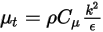
|
And the empirical modeling constants ( ), and turbulent Prandtl numbers (
 ) are listed in the following table:

|

|

|

|

|
|---|---|---|---|---|
| 0.09 | 1.44 | 1.92 | 1.0 | 1.3 |
Table 5.10 - Modeling Constants of Standard  Model
Model
For the source terms in  and
and  equations,
  is the turbulent production term from stress and strain;
  represents buoyancy-induced generation source, and its coefficient/ constant
  in
in  -equation is not explicitly specified but calculated;
  indicates the effect of compressibility on turbulence;
  and
and  are external/user source terms for
  and
and  respectively. These terms/models are the same for all the
  models, and they will be described later.
Turbulent Production
The turbulent production term has the exact expression:
|
|
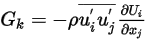
With the Boussinesq hypothesis, equation 5.91,  is modelled as follows:

|
|

|
|

|
where  is the modulus of the mean rate-of-strain tensor of
  , and is defined as:
|
|

It may be noted that in equation 5.96, the first term on the right,  , is commonly considered as the turbulent production term. The second term is generally referred to as the compressible/divergence term.
One may also note that when using the high-Re number version of  model with wall functions, the effective viscosity (
 ), rather than the turbulent viscosity
  , is often used in equation 5.96.
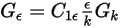
For the production term in the  -equation 5.93, it can be generalized as:
|
|
The Renormalization Group RNG k-ε model
The RNG-based  turbulence model is derived from the instantaneous Navier-Stokes equations, using a statistical technique called “renormalization group” (
 ) methods3S. A. Orszag, V. Yakhot, W. S. Flannery, F. Boysan, D. Choudhury, J. Maruzewski, and B. Patel, "Renormalization Group Modeling and Turbulence Simulations", In International Conference on Near-Wall Turbulent Flows, Tempe, Arizona. 1993.. The analytical derivation results in a model similar in form to the standard
  model but with different model constants, and additional terms/functions in the transport equations for
  and
and  . Consequently, the
  model is more accurate and reliable for a wider class of flows than the
  model such as rapidly strained flows, swirling flows and low-Reynolds number effects, etc. The transport equations for the
  model are as follows:

|
|

|
Comparing equation 5.92-equation 5.93 and equation 5.99-equation 5.100, one can see that the main differences between the  and the
  model lie in the diffusion coefficients, the turbulent Prandtl numbers (
 ) vs. the inverse turbulent Prandtl numbers (
 ) and the additional term
  in the
  -equation of the
  turbulence model.
Turbulent/Effective Viscosity
In the  model, the effective viscosity
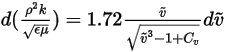
  appears directly in the diffusion terms of the modeling equations. It can be obtained by solving a differential equation resulting from the scale elimination procedure in
  theory:
|
|

|
where the constant  .
.
equation 5.101 is integrated to obtain an accurate description of how the effective turbulent transport varies with the effective Reynolds number (or eddy scale), allowing the model to better handle low-Reynolds number and near-wall flows. For fully turbulent flows, the high-Reynolds number limit of equation 5.102 returns to equation 5.94 , the same formulation as in the
  model but slightly smaller model constant,
  derived from the RNG theory. Therefore, the effective viscosity is usually computed using the high-Reynolds number form in equation 5.94. The differential equation 5.101 is only solved when it is necessary to include low-Re number effects in the turbulence model, which is not included in Simerics-MP.
Furthermore, the  model can account for the effects of swirl or rotation by modifying the turbulent viscosity
  with the following expression:

|
where  is a characteristic swirl number evaluated with flow vorticity, and
  is a swirl constant with a default/ minimum value of 0.07 for mildly swirling flows, while a larger value of
  can be used for strongly swirling flows.
Inverse Turbulent Prandtl Numbers
As for the inverse turbulent Prandtl numbers  and
and  , they are, as the value of
  , derived analytically using the RNG theory:

|
where  = 1.0. In the high-Re number limit (
  ),
),  .
.
The  -Term in
  -Equation:
As stated earlier, the major difference between the RNG and standard  models lie in the additional term in the
  -equation,
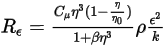
  , expressed as:
|
where  and
and  . It may be noted that
  is the modulus of the mean rate-of-strain tensor, as shown in equation 5.97.
The effects of this additional term in the  equation can be seen more clearly by combining
  and the destruction term in equation 5.100, which can be then rewritten as follows:

|
and
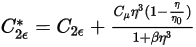
|
In regions where  , however,
  - term makes a positive contribution, and
  becomes larger than
  . In the logarithmic layer, for instance,
  is around 3. equation 5.107 gives
  , close to
  , the value in the standard
  model Table 5.10. As a result, for weakly to moderately strained flows, the
  model tends to give results largely comparable to the standard
  model.
In regions of large strain rate  , however,
  -term makes a negative contribution and
  . In comparison with the standard
  model, the smaller destruction term augments
  , reduces
  , and thus returns a smaller turbulent /effective viscosity. As a result, in rapidly strained flows, the RNG model yields a lower turbulent viscosity than the standard
  model. Therefore, one can say that the RNG model is more responsive to the effects of rapid strain and streamline curvature than the standard
  model, and thus more suitable for such flows.
The empirical modeling constants ( ) and the inverse turbulent Prandtl numbers (
 ) for the
  are listed in the following table:

|

|

|

|

|
|---|---|---|---|---|
| 0.0845 | 1.42 | 1.68 | 0.7194 | 0.7194 |
Table 5.11 - Modeling Constants of  Model
Model