|
You are here: Automotive Templates and Tutorials > Vehicle Template > Full Vehicle Modelling > Heat Exchanger Modelling
|
Heat Exchanger Modelling
The heat exchangers, such as condenser and radiators, are modelled using porous media model. Since the actual geometry may consist of a lot of tubes and fins, creating a mesh becomes complicated. The advantage of using porous media model is that there is no need to model the actual geometry. The heat exchanger is modelled using source terms, with a pressure drop across it.
|
This model incorporates a pressure drop (DP) that is a function of the fluid velocity (V). The flow resistance data is usually obtained from experimental results. In Simerics-MP+, the resistance model is activated to model the heat exchangers. The linear and quadratic coefficients are provided under the resistance model. The procedure for the calculation of coefficients is explained as follows: From the DP- V curve, the data (see, Table 7.1) is plotted in an excel sheet and obtained as the second order polynomial equation using trend line (see, Figure 7.10). Coefficients from the curve fit are: Linear Coefficient (a): 28.624 Quadratic Coefficient (b): 3.0983 Thickness of the radiator (t): 0.02536 m Calculated Linear Coefficient Calculated Quadratic Coefficient |
 = 1128.706
 = 103.276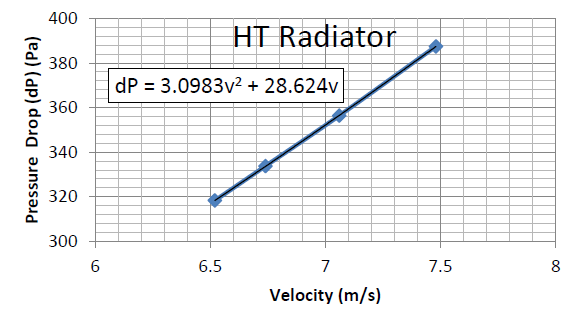
| Velocity (m/s) | Pressure, dp (Pa) |
|---|---|
| 6.52 | 318.3 |
| 6.74 | 333.8 |
| 7.06 | 356.4 |
| 7.48 | 387.5 |
Table 7.1 - Flow and Pressure data
| Note: For more information on derivation of porous media parameters, refer porous media. |