Ball Valve Meshing
This section explains the settings for the ball valve mesh generated using the Valve Template Mesher. This involves selection of the surfaces, directional characteristics of the mesh and other advanced mesh settings.
The parameters related to Ball Valve meshing can be accessed by setting the Setup Options to Advanced Mode or Template Mode , as shown in Figure 6.600
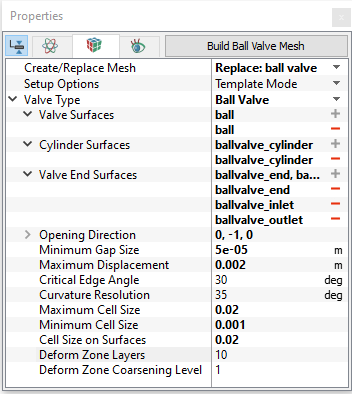
Figure 6.600 - Ball valve template mesher
Valve Surfaces
The Valve Surfaces corresponds to the moving boundaries of a valve chamber. They are assigned as follows:
- Select the valve surfaces under CAD Surfaces in the Geometric Entities Panel.
- Click Add Surfaces
 icon to the right of Valve Surfaces, or click Select Valve Surfaces in the Properties Panel.
Cylinder Surfaces
The Cylinder Surfaces of a valve chamber corresponds to the boundaries along which the mesh will slide and compress as the valve opens and closes.
- Select the cylinder surfaces under CAD Surfaces in the Geometric Entities Panel.
- Click Add Surfaces icon to the right of Cylinder Surfaces, or click Select Cylinder Surfaces in the Properties Panel. The Select Cylinder Surfaces operation automatically follows the Select Valve Surfaces operation.
Valve End Surfaces
The valve end corresponds to the stationary boundaries of a valve chamber (not included in the cylinder surfaces). They are assigned as follows:
- Select the valve end surfaces under CAD Surfaces in the Geometric Entities Panel.
- Click Add Surfaces icon to the right of Valve End Surfaces, or click Select Valve End Surfaces in the Properties Panel. The Select Valve End Surfaces operation automatically follows the Select Cylinder Surfaces operation.
Opening Direction
This is a vector indicating the direction that the valve opens. This dictates the side of the valve face used to determine the Closed Position, the Minimum Gap Size, and the location of the Full Closure Model. This also correspond to the Movement Direction used by the Translation (1 DOF) module connected via the Dynamics option.
Minimum Gap Size
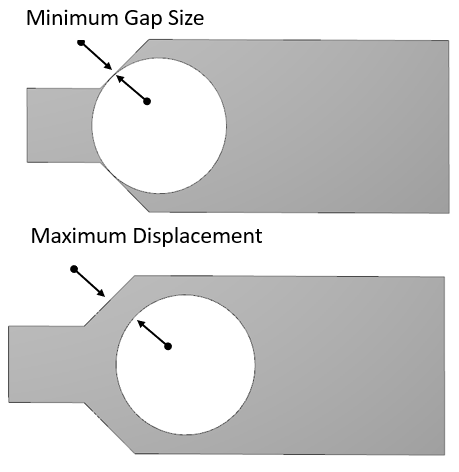
This is a numerical limit to avoid physical contact between valve and valve end surfaces when the valve is in closed position physically. At the same time, it also limits the over-compressing of mesh between valve and valve end surfaces while closing the valve. In other words, it is the minimum distance from the valve end at which the valve stops moving and limits the compression of mesh numerically.
- This is used by the valve mesher to optimize the mesh between the valve and valve end surfaces.
-
During valve motion, for any displacement value in the Dynamics module between zero and minimum gap size, the valve always stays at the minimum gap position. The valve end surface is considered as the reference for valve displacement value. The Zero displacement value corresponds to the valve touching the valve end physically.
-
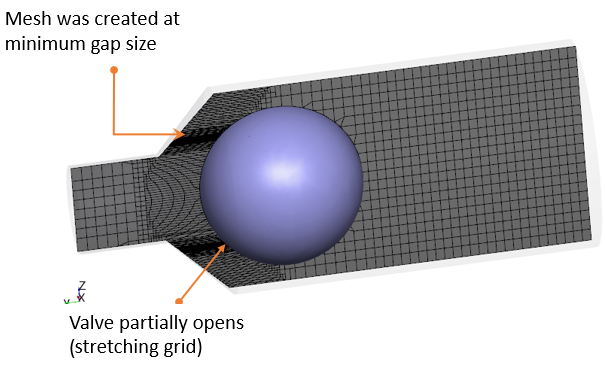
There is no default value for Minimum Gap Size. It requires an user input value (greater than zero). To the extent that does not create an excessive number of mesh cells, a small (micron scale) Minimum Gap Size is recommended. A possible disadvantage of using a small (micron scale) gap size during meshing is that it can create a mesh with an excessive number of grid cells if the contact area for the valve face is large relative to the Minimum Gap Size. This disadvantage can be avoided by meshing using a Minimum Gap Size larger than the actual minimum gap, and then subsequently reducing this gap to the desired value for the simulation in the dynamic module.
|
|
|
Maximum Displacement
This is related to the amount of mesh displacement (see, Figure 6.601) which can occur as the valve moves in the Opening Direction. During meshing, it is used by the valve template mesher to optimize the mesh. Specify the maximum value of displacement.
It is recommended to set this displacement to the approximate maximum distance the valve is expected to translate in the Opening Direction or, if that is not known, to a value slightly less or more than the maximum distance the valve could possibly open.
|
Note: The value of Minimum Gap Size and Maximum Displacement input during meshing are subsequently used to initialize the respective values in dynamic module. The value of Minimum Gap Size and Maximum Displacement can also be changed prior to running a simulation. |
The parameters Critical Edge Angle, Curvature Resolution, Maximum Cell Size, Minimum Cell Size and Cell Size on Surfaces are described in the General Mesher.
Deform Zone Layers
This specifies the number of mesh layers between the valve face and the valve end. It is the number of grid points "N" between the valve and valve end surfaces. The actual number of cells/grid lines in the generated mesh is usually (N-1), may not be exact due to the complexity of ball valve mesh itself. Specify the value in terms of positive integer.
Deform Zone Coarsening Level
This is an integer value used to determine the level of mesh coarsening outside the "deforming zone", where the valve surface and the valve end surface will be in physical contact. This value can usually be kept as the default value 1 in the mesh generation process. With a value of N (N greater than 1), the mesh outside the deforming zone is usually coarsened for (N-1) levels following the binary tree mesh structure. The actual mesh coarsening may not be as exact as (N-1), due to the complexity of the ball valve mesh itself. Specify the value in terms of positive integer.
Once the parameters for meshing are defined, click Build Ball Valve Mesh in the Geometry Tab of the Properties Panel. The mesh is created and added under the Built Meshes and the corresponding Volumes are generated in the Geometric Entities Panel. Also, respective valve module (Ball Valve) module is added to the Model Panel. When each chamber of a connected valve is meshed with template, only one valve module can be retained out of the valve modules that get added for each chamber. Creating mesh with template mesher automatically assigns the proper boundary conditions (Cylinder surfaces, Valve end and Valve) in the process.