Leakages
This section explains the settings for specifying the leakages in the gerotor chamber.
The parameters related to Gerotor leakages can be accessed by setting the Setup Options to Advanced Mode.
|
Note: If the leakage has an arbitrary shape, it can be modelled using general mesher. |
Side Gap Option
The two types of side gaps are:
A) Uniform Side Gaps
Description
This creates a leakage gap with uniform thickness, whose value is specified under Side Leakage Gap.
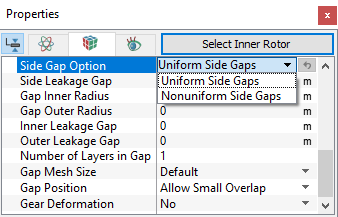
Figure 6.84 - Uniform side gaps-Gerotor
The parameters associated with Uniform Side Gaps are:
Side Leakage Gap
This corresponds to the height of the axial gap above and below the pumping chamber. Depending on the CAD Surfaces, the rotor surfaces are either manipulated or not, to create these side leakage gaps. A non-zero value of the Side Leakage Gap will cause a leakage gap Volume to be created. The rotor is shrunk on both ends to accommodate the gap, with a quarter of a cell overlap at the boundaries. Two gaps are created, each with thickness specified under Side Leakage Gap, above and below the gerotor volume and are automatically connected to the rotor volume via MGIs. They must be connected to the port volumes via MGIs.
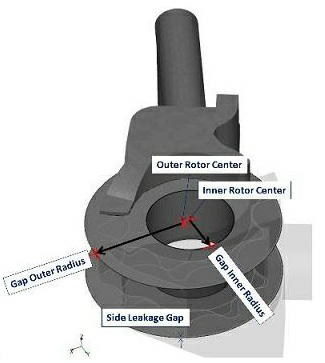
Figure 6.85 - Side leakage gap
|
Note: To prevent unrealistic overlap of the gap, the original CAD geometry should have no overlap between the ports and the rotors. The boundary of the ports should not be refined to be “too” small, i.e. not less than a quarter of the size of the gap mesh cells. |
Gap Inner Radius
This corresponds to the inner radius of the Side Leakage Gap (axial gap) and also the position of the Inner Leakage Gap (radial gap). This radius is taken relative to the Rotational Axis Vector (see, Figure 6.85) and the center for this radius coincides with the Inner Rotor Center.
Gap Outer Radius
This corresponds to the outer radius of the Side Leakage Gap (axial gap) and also the position of the Outer Leakage Gap (radial gap). This radius is taken relative to the Rotational Axis Vector (see, Figure 6.85) and the center for this radius coincides with the Outer Rotor Center.
Inner Leakage Gap
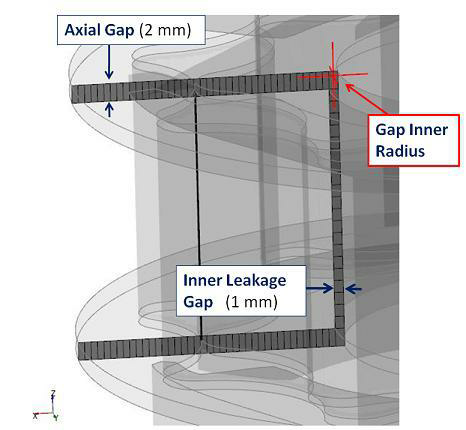
This corresponds to the radial gap between the shaft and the inner rotor. A non-zero value of the Inner Leakage Gap will cause a leakage gap Volume to be created. When used in conjunction with Side Leakage Gap, the inner and side leakage gaps are connected directly (i.e. without any MGIs) as shown in Figure 6.86.
|
Figure 6.87 - Outer leakage gap |
Outer Leakage Gap
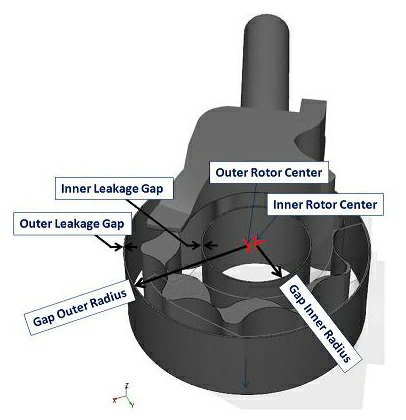
This corresponds to the width of the radial gap on the outer side of the outer rotor. A non-zero value of the Outer Leakage Gap will cause a leakage gap Volume to be created. A gap with width specified as the Outer Leakage Gap will be inserted automatically and connected to the Side Leakage Gap (if present). When used in conjunction with Side Leakage Gap, the inner and side leakage gaps are connected directly (i.e. without any MGIs).
|
Note: The Inner Leakage Gap and Outer Leakage Gap will propagate on either side of Gap Inner Radius and Gap Outer Radius respectively. |
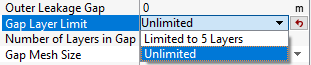
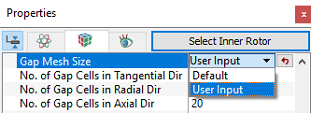
Gap Layer LimitAllows to limit number of mesh layers under Limited to 5 Layers option and allows to add more than 5 mesh layers in gaps under Unlimited option, as shown in Figure 6.88. This option gives user additional control for Number of Layers in Gap, as shown in Figure 6.88. When the Limited to 5 Layers option (the default option) is selected, user can only set up to 5 layers for Number of Layers in Gap. When Unlimited option is selected, user can set any number of layers for Number of Layers in Gap.
|
Gap Position
This allows the user to select the position of Side Leakage Gap (axial gap), between the rotors and ports. The options to specify the gap position are as follows:
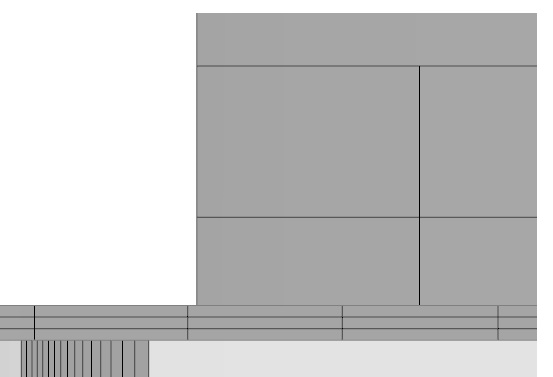
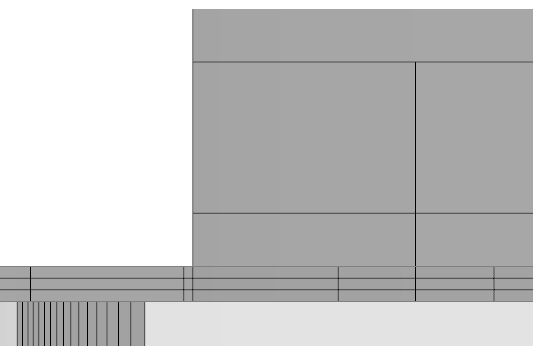
Allow Small Overlap: The rotor is shrunk on both ends to accommodate the gap, with a quarter of a cell overlap at the boundaries. This is used when there is no gap between the rotor and ports in the CAD.
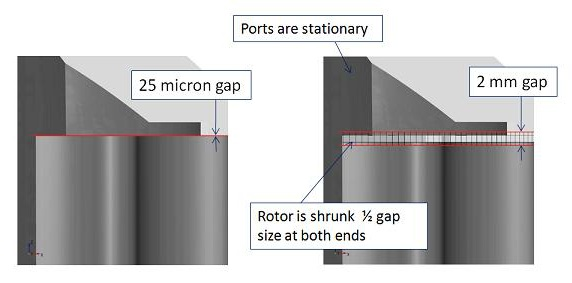
Figure 6.90 - Gap Position |
Figure 6.91 - Allow small overlap |
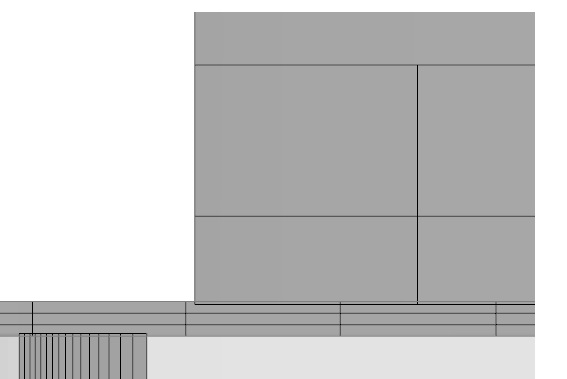
Shrink Rotor: The rotor is shrunk as needed on both ends to accommodate the gap with no overlap at the boundaries. This is used when there is no gap between the rotor and ports in the CAD.
Gap Outside Rotor: The rotor is not shrunk and the gap is placed between the rotor and ports. This requires that space for the gap has already been created in the CAD.
|
Figure 6.92 - Shrink rotor |
Figure 6.93 - Gap outside rotor |
B) Nonuniform Side Gaps
 Description
This creates a leakage gap with nonuniform thickness, with corresponding values specified under Bottom Leakage Gap and Top Leakage Gap. The other inputs defined in Nonuniform Side Gaps i.e., Gap Inner Radius, Gap Outer Radius , Inner Leakage Gap, Outer Leakage Gap, Gap Mesh Size and Gap Position are same as in Uniform Side Gaps.
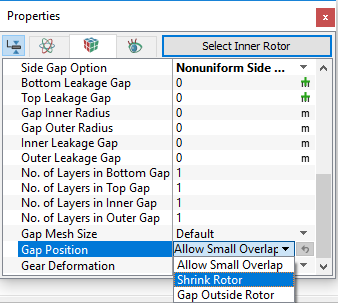
The parameters associated with Nonuniform Side Gaps are:
Bottom Leakage Gap: Creates a leakage gap at the bottom of the rotor.
Top Leakage Gap: Creates a leakage gap at the top of the rotor.
No. of Layers in Bottom Gap: Controls the number of mesh layers within the bottom leakage gap.
No. of Layers in Top Gap: Controls the number of mesh layers within the top leakage gap.
No. of Layers in Inner Gap: Controls the number of mesh layers within the inner leakage gap.
No. of Layers in Outer Gap: Controls the number of mesh layers within the outer leakage gap.
|
Note: The number of cells in the bottom, top, inner and outer leakage gaps can have different values. |