|
You are here: Fluid Machinery Templates and Tutorials > Translational Valve > Model > Operating Parameters
|
Operating Parameters
The operating parameters pertaining to the valve template involves dynamics & configuration for valves and other advanced/extended settings for the simulation (see Figure 6.517).
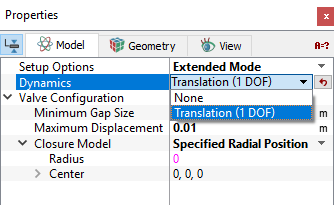
Figure 6.517 - Spool Valve model - Properties panel
Dynamics
This allows linking the valve model to an activated Translation (1 DOF) module. The Translation (1 DOF) module must have been previous activated via Select Modules to be available for linking. Multiple, physically unconnected valves should be modelled with separate valve modules and should be linked to separate Dynamics modules.
Valve Configuration
This allows the user to specify valve parameters. The parameters Minimum Gap Size and Maximum Displacement are specified under this category.
Closure ModelThis model enables the simulation of a valve closing completely, without having to compress the corresponding mesh volumes to zero. Features of closure model
To block the flow through the gap between valve body and valve seat, solver will define a “closure” surface between valve body and valve seat surfaces. The flow through the closure surface will be blocked based on the predicted gap size. This surface can be defined by the following ways: |
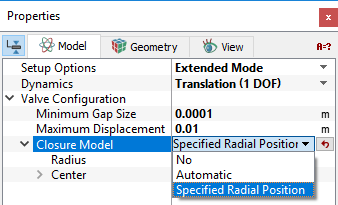
Automatic
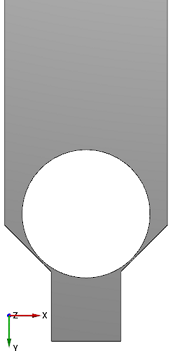
In this approach, software try to find the closure surface automatically without additional user input. For many valve designs, when a valve is fully closed, the valve body and the valve seat will be in contact with each other through a (often circular) line. The contact between valve body and valve seat will stop the flow. Software try to created the closure surface along the line of contact between valve body and valve seat. This approach works for most axial and ball valves where a clear line of contact exists.
|
|
Specified Radial Position
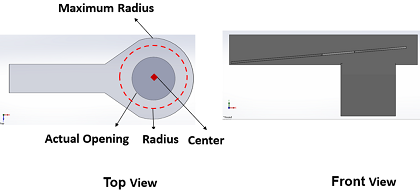
Another way of specifying the closer model is by providing the radial position of the closure surface. This approach works for all kinds of valves including flip valve and axial type of valves. User need to provide the center and the radius so that the location of a cylindrical valve closure surface is determined. Figure 6.520 shows the front and top view of a flip valve. The input radius value should be larger than the actual radius of the opening the valve plate supposed to cover as shown in red dotted circle. And the circle should not go outside of the valve body boundary.
One requirement for the valve closure model to work, is that there should not be any flow passage which can bypass the closure surface. The bypass passage maybe introduced due to the improper division of the fluid volumes, insufficient mesh resolution, or issues in geometry.