5.4.1 Definitions
- Vapor: The gas phase of a liquid substance at a temperature lower than its critical temperature, e.g., water vapor.
- Non-Condensable Gas (NCG): Any gas in the liquid that is different from the liquid’s own vapor. As such, it can dissolve or be released, but is not generated or absorbed by evaporation or condensation. The density is computed based on the gas molecular weight, the local pressure and temperature, according to the ideal gas law.
- Aeration: The component of the Cavitation model that accounts for the NCG in a liquid system.
- Dissolved Gas: The NCG dissolved in the liquid. It is included in the Equilibrium Dissolved Gas Model, Dissolved Gas Model and Full Gas Model.
-
Volume Fraction: The volume of component divided by the total volume within a selected volume or at a point.
- Dissolved Gas Volume: The total volume of the dissolved NCG in a liquid for a selected volume. The density of the dissolved gas is made up to be the same as the liquid density.
- Dissolved Gas Volume Fraction: The Volume Fraction volume fraction of the Dissolved NCG in a liquid for a selected volume.
- Dissolved Mass Fraction: The mass fraction of the dissolved NCG in a liquid at a given location.
- Vapor Mass Fraction: The total mass fraction of vapor in the fluid.
- Vapor Volume: The total volume of the vapor in a liquid for a selected volume.
- Vapor Volume Fraction: Volume fraction of the vapor. In the Add XY-Plot menu it is abbreviated as Vapor vol fraction.
- Gas Mass Fraction: The mass fraction of the non-dissolved (free) NCG in the fluid. Example- mass fraction of free air in liquid water. It is also referred to as Free Gas Mass Fraction, which does not include any dissolved Non-Condensable Gas.
- Gas Volume: The total volume of the free NCG in a liquid for selected volumes.
- Gas Volume Fraction: The volume fraction of the free NCG in a liquid for selected volumes. It is abbreviated as Gas Vol Fraction.
- Liquid Volume: The total volume of the liquid for selected volumes.
- Liquid Volume Fraction: The volume fraction of the liquid for selected volumes.
- Total Volume Fraction: Local volume fraction of the combination of free NCG, dissolved gas and vapor relative to the total fluid volume.
- All Gas Volume: The combined volume of the free NCG, dissolved gas and vapor in a liquid for a selected volume.
- All Gas Volume Fraction: The average volume fraction of the free NCG, dissolved gas and vapor in a liquid for a selected volume. It is abbreviated as All Gas Vol Fraction.
- Effective Bulk Modulus with Cavitation: For cavitating flows, the effective bulk modulus (
 ) is based on the mixture of the liquid and gas. Following the Nykanen-model (Nykanen 2000),
  is defined in terms of the mixture density (
 ) of liquid, vapor and non-condensable gases:
|
Note: Total Volume Fraction has the same meaning as All Gas Volume Fraction. The only difference is the first is used in the Derived Variable Menu for Display in the GUI Viewing Window, while the latter is used in the Integrated Output recorded for selected volumes. |
|
5.161 |

5.162 |

where the subscripts " " , “
" , “ " and “
 " represent the liquid, vapor and all the non-condensable free gases in the system respectively.
  indicates the mass fraction,
  is the local flow pressure and
  is the liquid bulk modulus. Note that the mixture density is also referred to as effective fluid density defined in equation 5.164.
-
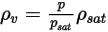
Effective Vapor Density: Without the consideration of the temperature effect, the local (effective) vapor density is calculated using the Boyle’s Law:
5.163
where
 and
and  are the saturation pressure and density at the given temperature.
If the temperature varies (i.e. the Heat module is active), the vapor density (at saturation) is also a function of temperature. The Expression Editor can be used to include the thermal effects.
- Effective Viscosity: Viscosity of the fluid mixture in the domain. Simerics-MP by default, do not include the effects of Vapor or NCG on the mixture viscosity (liquid viscosity only)
- Fluid Density (Effective) with Cavitation: The Effective Fluid Density is calculated based on the respective mass fractions and densities of the liquid, fluid vapor and NCG (e.g. air) according to the following formula:
|
|
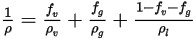
where  ,
,  ,
,  and
and  follows their respective laws of density; and
  ,
,  and
and  are either directly specified or obtained from solving transport equations, depending on the components and cavitation models.
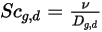
- Schmidt Number: The Schmidt Number is defined as:
- Gas Schmidt Number: The Gas Schmidt Number is the Schmidt Number of the NCG in a liquid. It is used to compute the mass diffusivity
 in the Variable Gas Mass Fraction model and Full Gas Model. It is given as:
 - Dissolved Gas Schmidt Number: The Dissolved Gas Schmidt Number is the Schmidt Number of the dissolved NCG in a liquid. It is used to compute the mass diffusivity in the Dissolved Gas Model. It is given as:
-
Vapor Schmidt Number: The Vapor Schmidt Number is the Schmidt Number of the vapor in the liquid. It is used to compute the mass diffusivity
 of the vapor in all Cavitation models. It is given as:

|
where

|
Kinematic viscosity (m2/s) |

|
Mass diffusivity (m2/s) |

|
Dynamic viscosity (Pa-s) |

|
Density (kg/m3) |

|
where

|
Kinematic viscosity of the primary fluid (m2/s) |

|
Mass diffusivity of the NCG through the liquid (m2/s) |
|
where

|
Mass diffusivity of the NCG through the liquid (m2/s) |

|
where

|
Mass diffusivity of the vapor in through the primary liquid (m2/s) |