Cavitation Models
In Simerics-MP, as in the original Singhal et al model1Singhal, A.K., Athavale, M. M., Li, H., and Jiang, Y., “Mathematical Basis and Validation of the Full Cavitation Model”, ASME Fluids Engineering Division Summer Meeting, New Orleans, USA, 2001., the working fluid in cavitating flows is always assumed to be a mixture of liquid, vapor and some non-condensable gases. By default, the cavitation models account for both liquid-vapor phase change and the effect of non-condensable gases. Based on the modelling approach for non-condensable gas effect, five different model options, (summarized in Table 5.17 are provided for the prediction of the aeration and cavitation in a liquid system. These models are described in detail in this section.
| Models for NCG | Description |
|---|---|
| Constant Gas Mass Fraction | Mass fraction of the NCG is constant and considered to be out of solution (i.e. tiny compressible bubbles). |
| Variable Gas Mass Fraction | Similar to the Constant Gas Mass Fraction model, but the mass fraction of NCG can vary (e.g. inlets can introduce different mass fractions.) |
| Equilibrium Dissolved Gas Model | Mass fraction of the NCG dissolved in the liquid is equal to the equilibrium value |
| Dissolved Gas Model | Mass fraction of the NCG dissolved in the liquid depends on the rate of absorption/desorption and the equilibrium value |
| Full Gas Model | Combines the Dissolved Gas Model and Variable Gas Mass Fraction |
|
Note: All cavitation models solve the vapor transport equation 5.172 with the mass transfer models based on equation 5.197 and equation 5.198. |
Constant Gas Mass Fraction Model
The constant gas mass fraction model is the basic/default cavitation model in Simerics-MP. It is based on the work by Singhal et al. In this model, it assumes that in the working fluid, the ever-present non-condensable gas (NCG) in the liquid is non-dissolvable gas (free gas) bubbles following the ideal gas law. Though all the pre-described non-condensable gas can freely expand with the decrease of the pressure in cavitating zones, the mass fraction of non-condensable gases is pre-described and remains the same in a cavitating flow:

|
where  is a user-specified value.
The density of the non-condensable gas follows the ideal gas law:

|
where  is the fluid temperature, which can be pre-described (isothermal flow), or obtained by solving the mixture energy conservation equation 5.171 when heat transfer is considered. From equation 5.176, the volume fraction of the non-condensable is as:

|
Clearly, though the mass fraction of NCG is fixed and usually has a very small value (e.g., in natural water it is typically 2.3e-05 or 23 ppm), its volume fraction  varies and can be considerably larger in value. In fact, in cavities (low pressure zones), the non-condensable gas competes with the vapor to fill the void in space depending on the gas and vapor densities.
As for the liquid-vapor mass transfer, equation 5.197 and equation 5.198 serve as the foundation to construct the cavitation source and sink term in the vapor mass fraction equation 5.172. Specifically, the bubble radius,  , needs to be estimated using the known flow quantities during both bubble growth and collapse. Singhal et al argued that if the typical bubble size
  is the same as the limiting (maximum possible) bubble size,
  can then be determined by the balance between the aerodynamic drag and surface tension forces. A commonly used correlation in the nuclear industry is:
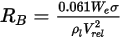
|
where  is the magnitude of the liquid-vapor relative velocity. In the bubbly flow regime (under which cavitation occurs),
  is generally small, e.g., 5-10% of liquid velocity. Moreover, by using various limiting arguments, e.g.
  →0 as
→0 as  →0, and the fact that the phase change rates per unit volume should be proportional to the volume fractions (or mass fractions) of the donor phase, the following expressions for vapor generation / condensation rates are obtained to complete the cavitation model as:

|
where

|

|
where  and
and  are the evaporate and condensate coefficients, which can be user-specified constant values (by default, both are set to 1.0) or functions of known flow quantities.
It may be noted that in equation 5.225 and equation 5.226, a new threshold pressure  is introduced to replace the saturation vapor pressure
  in equation 5.197 and equation 5.198. According to Singhal et al, to account for the effect of turbulence on cavitating flows, observed by experimental investigations, a local value of the turbulent pressure fluctuations given by Hinze [6]:
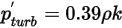
|
is added to the saturation vapor pressure to raise the phase-change threshold pressure value to:

|
Obviously, for laminar flows,  .
.
It may be pointed out that when heat transfer is considered, in addition to the fact that all the phase densities (liquid, vapor and non-condensable gases) are subjected to changes with temperature, the saturation vapor pressure  is also a function of temperature. Consequently, the direct thermal effect on cavitation can be somewhat taken into consideration in this cavitation model.
Variable Gas Mass Fraction Model
The variable gas mass fraction model assumes that the non-condensable gas always remains as a free gas (cannot be dissolved into the liquid) but the mass fraction is no longer a pre-described constant as in the constant gas mass fraction model. Instead, the distribution of the local mass fraction is governed by a transport equation. As for the liquid-vapor mass transfer, it is modelled by the same cavitation model, equation 5.224-equation 5.226. For clarity, the complete set of the modelling equations is given below:
Liquid-Vapor Phase Change

|
where

|

|
Non-Condensable Gas Transport Equation
Following equation 5.202, the transport equation for the non-condensable gas ( ) has the form:

|
where  is the external/user-defined source for the non-condensable gas.
Equilibrium Dissolved Gas Model
In cavitating flows, the non-condensable gases presented in the fluid can be either dissolved into or released from a liquid to achieve a dynamic equilibrium of the mass concentrations between the liquid and gas phases. In this equilibrium dissolved gas model, it assumes that the mass fraction of the total non-condensable gas remains as a constant, but a part of it is dissolved into the liquid to instantly satisfy the local equilibrium condition. Mathematically, in addition to the same vapor mass fraction equation and vapor mass transfer models, it solves an additional transport equation for the mass fraction of the dissolved gas  , which is assumed to be always in equilibrium state. The modelling equations are as follows:
Liquid-Vapor Phase Change

|
where

|

|
Gas Absorption/Dissolution or Release
From equation 5.200, equation 5.214 and equation 5.215, the dissolved gas transport equation has the form:

|
where  is the user-defined law of gas dissolution or release;
  is the equilibrium mass fraction of the dissolved gas at the reference pressure
  , and both model parameters
  and
and  have user-specified values. In this equilibrium model, the time scale
  approaches zero so that the mass transfer is near instant.
Note that in equation 5.234, the free gas has the mass fraction  , instead of
  . And the mass fraction of the free gas is obtained from the condition:

|
where  is a user-specified value.
Dissolved Gas Model
Different from the equilibrium dissolved gas model, the dissolved gas model relaxes the condition that the dissolved gas in the liquid is always at the equilibrium state. In other words, instead of being determined by the equilibrium condition with instant mass transfer, the mass fraction of the dissolved gas ( ) depends on the transport of the component and the dissolution/release rate (finite rate). Therefore, the dissolved gas model shares the same modelling formulations as the equilibrium dissolved gas model, equation 5.233 - equation 5.237. However, the finite rates of mass transfer for gas dissolution and release are characterized by the different time scales (
 ). Specifically, for the gas absorption/dissolution into the liquid,
  is given by a specified absorption time (Dissolved Gas Dissolve Time, by default, it is 10 s), while for the release of dissolved gas from the liquid, the rate of mass transfer is dictated by a specified gas release time (Dissolved Gas Release Time by default
  is 10 s).
Full Gas Model
The full gas model is a combination of the dissolved gas model and variable gas model: the mass fraction of the non-condensable gas is subjected to change with time and space, while the gas dissolution/absorption and release can also occur for the non-condensable gases. The complete set of modelling equations is written in the following:
Liquid-Vapor Phase Change

|
where

|
|

|
Transport of Non-Condensable Gas

|
Gas Dissolution or Release

|