5.4 Cavitation
Cavitation is the phenomenon where vapor cavities (small but largely liquid-free zones, commonly referred to as "bubbles" or "voids") are generated in a liquid due to the imbalance of the local dynamic forces. It usually occurs when a liquid is subjected to rapid changes of pressure under isothermal conditions: if the pressure falls below a threshold (saturation vapor pressure), the liquid would rupture and form vaporous cavities, while the voids would implode (bubbles collapse) and generate intense shock waves when the vapor bubbles are subjected to a pressure higher than the threshold pressure.
For a liquid flow, its tendency to cavitate can be characterized by the cavitation number, defined as:

|
where  is the absolute value of the flow reference pressure (for example, inlet pressure);
  is the saturation vapor pressure, which is a material property depending on the temperature and pressure; the denominator represents the flow dynamic head (may be written in a different form), in which
  is the liquid density and
  is the free-stream velocity. Clearly, equation 5.160 indicates that as the cavitation number is decreased, a liquid flow more likely tends to be cavitated.
Steady and unsteady cavitating flows can occur in many fluid engineering systems. Some typical examples include (but are not limited to) fuel injectors, liquid pumps, propellers, impellers, hydrofoils, hydrostatic bearings and bio heart valves. Cavitation is, in many cases, an undesirable occurrence. It can cause significant degradation in performance, as manifested by reduced mass flow rates, lower head rise in pumps, load asymmetry, vibration and noise. Cavitation can also cause physical damage to a device due to bubble impact on surfaces, which can ultimately affect structural integrity. To minimize cavitation or account for its presence, a detailed knowledge of the existence, extent and behavior of cavitation is essential during the initial design stages. Therefore, it is of ultimate importance in CFD to provide an accurate and reliable modelling capability of cavitation. Indeed, the flagship product of Simerics-MP offers a complete Cavitation module along with customized tools (templates), for the simulation of cavitating flows occurring in a wide range of fluids systems.
In this chapter, the modelling theory and the cavitation models adopted in Simerics-MP are described. The model parameters and settings, the work flow and the post-processing quantities are also discussed in detail. Note that since cavitation is a thermal phase change process between the liquid and vapor phases, it can be modelled as an interface mass transfer under multiphase flows. In Simerics-MP however, cavitation is for the legacy of PumpLinx still modelled independent of Multiphase module.
|
To activate the Cavitation module:
|
Figure 5.68 - Cavitation module |
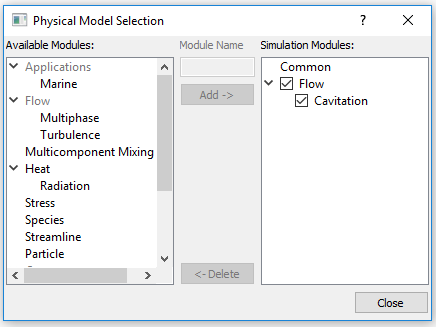
The module is explained as follows:
- Definition: Terminologies relevant to the Cavitation module.
- Physics: Models, methods and constants used in the Cavitation module.
- Conditions : Specifying conditions for the entities-boundaries, interfaces, volumes under the Cavitation module.
- Output: Outputs from the Cavitation module.