Governing Equations
With cavitation transport models, the bulk motion of mixture of the liquid and gas (vapor and other possible gases) is treated as a variable density single-phase flow. The set of general governing equations for the mixture flow is the same as that for multi-component flows, while a transport equation is specifically formed to govern the vapor mass fraction generated in cavitation. To model the effects of non-condensable gases, additional transport equations for gas mass fractions may also be solved depending on the gas models. For clarity, the complete set of general governing equations solved for cavitating flows is first presented here:
Continuity

|
Momentum Equations

|
Energy Equation

|
Vapor Mass Fraction Equation

|
Non-Condensable Gas (NCG) Mass Fraction Equation(s)

|
where  in equation 5.169is the net external/user source independent of cavitation. In equation 5.172,
  is the vapor mass fraction;
  is the vapor generation source (evaporation);
  is the sink term (condensation); and
  is the external/user-defined vapor source term. As for equation 5.173, it is a general transport equation for non-condensable gases (NCG), including generation, sink and external/user-defined source terms. Depending on the cavitation models, different equations (between zero and two) may be solved (non-condensable gas, dissolved gas, etc.).
For turbulent flows, the turbulent viscosity  is obtained from solving the turbulence modelling equations. And the turbulent Prandtl numbers
  ,
,  and
and  are pre-described model parameters. The details of the turbulence models can be found in the Turbulence module.
In the transport equations, the mixture properties are computed using the following relations:
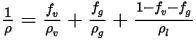
Mixture Density
|
where  and
and  are the densities of vapor, non-condensable free gas and liquid, respectively. The liquid and vapor density can be constant (incompressible) and/or variable (compressible). But the non-condensable free gas density is always considered as an ideal gas in the cavitation models. Note that in equation 5.174, the liquid mass fraction
  is computed using the physical constraint: the mass fractions of all the components sum to unit, namely:

|
In cavitating flows, the parameter of interest is the vapor ( ) or total gas-phase volume fraction (
 ), which can be deduced from the solved mass fraction
  , and the free gas mass fraction,
  :
:

|
|

|
Mixture Viscosity

|
where  and
and  are the dynamic viscosity of vapor, non-condensable free gas and liquid, respectively.
Mixture Thermal Properties

|
|

|
|

|
where  and
and  are the thermal conductivity, specific heat for a constant pressure process and specific enthalpy. For the components involved, they are denoted with specific subscripts for vapor (
 ), non-condensable free gas (
 ) and liquid (
 ) respectively.