Boundary Conditions
|
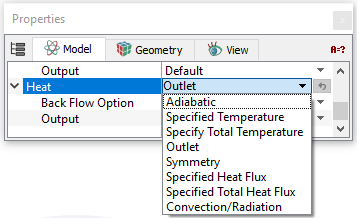
The boundary conditions and associated Heat parameters are specified as follows: |
Figure 5.135 - Boundary conditions |
Adiabatic
|
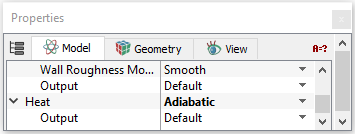
This is a thermal boundary condition in which the heat flux is set to zero (as if insulated). The Adiabatic Boundary Condition is the default condition for the Heat module when a Wall or Rotating Wall boundary condition is selected for the Flow module . |
Figure 5.136 - Adiabatic |
Specified Temperature
|
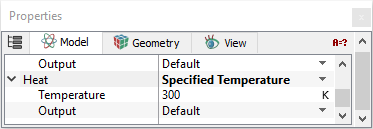
This is used whenever the temperature at a boundary is known. The Specified Temperature is the default boundary condition when a Specified Velocity, Specified Volumetric Flux, Specified Total Pressure or Specified Pressure Inlet is selected for the Flow module. The temperature of any fluid exiting the domain is based on the internal (upwind) temperature. The temperature of any fluid entering the domain is based on the Specified Temperature. In addition to any convective effects, it influences the internal temperature via conduction. |
Figure 5.137 - Specify Total Temperature |
Specify Total Temperature
|
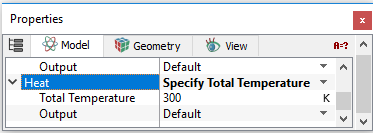
This is used whenever the total temperature at a boundary is known. The temperature of any fluid exiting the domain is based on the internal (upwind) temperature. The temperature of any fluid entering the domain is based on the Specify Total Temperature. In addition to any convective effect, this temperature influences the internal temperature via conduction. |
Figure 5.138 - Specified total temperature |
Outlet
|
This is used at an opening where flow is expected to exit the domain. In case of back flow, the temperature of the incoming fluid is specified by the User Specified or Fully Developed under Back Flow Option:
|
Figure 5.139 - Outlet |
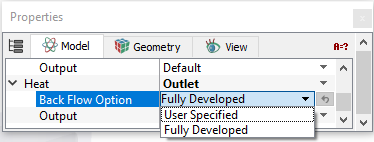
The Outlet boundary condition is the default condition when a Specified Pressure Outlet or Resistor Capacitor boundary condition is selected for the Flow module. The temperature of the fluid exiting the Outlet is based on the internal (upwind) temperature. The temperature of any fluid re-entering the domain is based on the Specified Temperature which influences the internal temperature via conduction. Typically, this effect is insignificant unless the outflow is either very small or the conductivity very high).
|
Note: The boundary condition Specify Total Temperature or Outlet is activated when Flow module is active. |
Symmetry
|
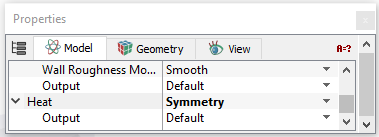
This implies that there is no heat flux or temperature gradient normal to the boundary. Symmetry for the Heat module is the same as the Adiabatic boundary condition. This usually corresponds to a physical symmetry in the model, but it doesn’t have to, as long as the effects of this boundary condition make sense. |
Figure 5.140 - Symmetry |
Specified Heat Flux
|
This is used to specify the heat flux per area on the boundary. This allows specifying heat flux as a function of The direction of the heat flow is decided using these options:
|
Figure 5.141 - Specified Heat Flux |
 location (using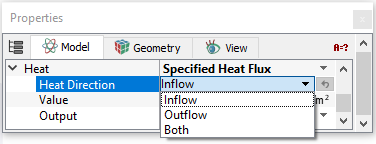
Specified Total Heat Flux
|
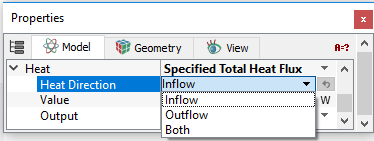
This is used to specify the total heat flux on a boundary. The specified Value is uniformly distributed (by area) across the boundary. The heat flux for each cell face on the boundary is calculated as follows:
The direction of the heat flow is decided using these options: Inflow, Outflow, or Both. |
Figure 5.142 - Specified Total Heat Flux |

Convection/Radiation
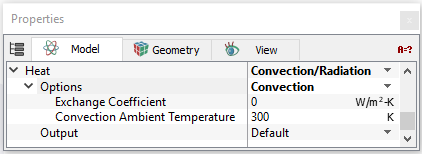
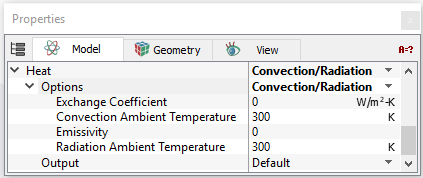
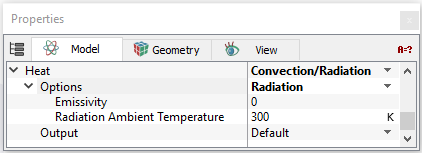
This is a thermal boundary condition in which the heat flux is a function of the external convection and/or radiation. The different conditions under this are listed below:
|
Figure 5.143 - Convection |
||
|
Figure 5.144 - Convection/radiation |
|
|
Figure 5.145 - Radiation |