5.11 Streamline
|
In the module, Particle, the trajectory of a particle’s movement through a continuous fluid flow is tracked by solving the equations of motion for the particle (derived from force balance) in a Lagrange system. For the discrete particle model, the underlying physical mechanism is that between the continuous fluid phase and the particles, there are relative motions and thus momentum exchanges. Consequently, the particle tracking, often coupled with flow simulations, is essentially a transient process, since the velocity and position of each particle depends on its initial conditions and the local flow field where the particle travels at a given time. For many flow simulations, in particular for steady-state runs, it is desirable to display/visualize the flow paths/streamlines, a family of curves that are tangent to the velocity vector of the flow. To create the flow streamlines, massless particles, whose size (radius) and numbers do not have any influence on the flow, are imagined to be released from boundaries and they travel along with the fluid flow. In other words, with the massless particles sharing the flow velocity, one can determine the flow streamlines by tracking the massless particle motions in the flow domains since the trajectories of the particles are identical to the flow paths at any given point. The module, Streamline is therefore introduced to create streamlines primarily for the post-processing of steady-state flow simulations. Note that for transient simulations, Particles can be displayed as an alternative to streamlines.
To activate the Streamline module:
|
Figure 5.246 - Streamline module |
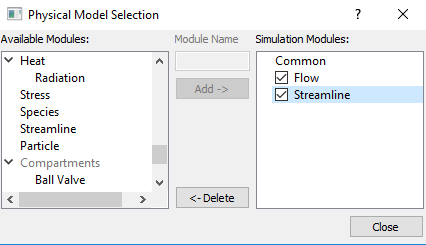
The module is explained as follows:
- Physics: Terminology and equations used in the Streamline module.
- Boundary Conditions: Specifying conditions for the boundaries and interfaces under the Streamline module.
- Volume Conditions: Specifying streamline conditions at the volume level under the Streamline module.
- Display settings: Settings related to the display of streamlines.