5.4.4 Output Variables
This section explains the outputs available in the Cavitation module. They are categorized as follows:
- Primary Variables
- Property Variables
- Derived Variables
- Integrated Quantities
- Avg/Max Vapor Volume Fraction Distribution
- Avg/Max Gas Volume Fraction Distribution
- Avg/Max Vapor Rate Distribution
- Avg/Max Gas Rate Distribution
- Avg/Max Vapor Damage Power Distribution
- Avg/Max Gas Damage Power Distribution
- Gas Volume Fraction Distribution
- Gas Damage Power Distribution
|
Note: In order to display the contours and X-Y plots, or to write the outputs into an ascii file, the outputs on each Geometric entity (such as Boundary, Volume, Interface or Points) need to be activated in the Model Tab of the Properties Panel. |
Primary Variables
Primary Variables are the fundamental variables that characterize the physical process in the module. They are usually obtained by directly solving transport equations or through physical constitutions. The primary variables can be displayed in the GUI Viewing Window for selected Geometric Entities as well as written to the ascii file Filename_points.txt. They can also be viewed as X-Y Plots for Point Probes.
For the Cavitation module, a list of Primary Variables is shown in the table below:
| Cavitation Module Primary Variables | ||||||
|---|---|---|---|---|---|---|
| Label in Results Panel Variables List | Label in GUI X-Y Plot Menu | Label in points.txt | Definition | Units | Display/Output Options | Relevant Cavitation Models |
| Gas Mass Fraction | Gas Mass Fraction | Fgas_ | NCG mass fraction (over fluid mass) | - | At a Point and in the GUI Display Window | All |
| Vapor Mass Fraction | Vapor Mass Fraction | Fvap_ | Vapor mass fraction (over fluid mass) | - | At a Point and in the GUI Display Window | All |
| Dissolved Gas Mass Fraction | Dissolved Gas Mass Fraction | Dgas_ | Dissolved NCG mass fraction (over fluid mass) | - | At a Point and in the GUI Display Window | Equilibrium Dissolved Gas, Dissolved Gas, Full Gas |
Table 5.22 - Cavitation module primary variables
Primary Variables are automatically activated for output on selected Geometric Entities, including Boundaries, Derived Surfaces, Interfaces, Streamline, Particles and/or Volumes, depending on the modules selected.
Property Variables
Property Variables are the physical properties for the fluid(s) and solid(s) in the domain. They are required as a part of the solution. They may be displayed in the GUI Viewing Window for selected Geometric Entities as well as written to the ascii file Filename_points.txt (when activated). They can also be viewed as X-Y Plots for Point Probes.
For the Cavitation module, a list of Property Variables is shown in the table below:
| Cavitation Module Property Variables | ||||||
|---|---|---|---|---|---|---|
| Label in Results Panel Properties List | Label in GUI X-Y Plot Menu | Label in points.txt | Definition | Units | Display/Output Options | Relevant Cavitation Models |
| Gas Schmidt Number | Gas Schmidt Number | Sg_ | Schmidt number of the NCG | - | At a Point and in the GUI Display Window | Variable Gas Mass Fraction, Dissolved Gas, Full Gas |
| Vapor Schmidt Number | Vapor Schmidt Number | Sv_ | Schmidt number of the NCG | - | At a Point and in the GUI Display Window | All |
| Dissolved Gas Schmidt Number | Dissolved Gas Schmidt Number | Sd_ | Schmidt number of the Dissolved NCG | - | At a Point and in the GUI Display Window | Dissolved Gas, Full Gas |
As shown in Figure 5.78, Property Variables are automatically activated for output on selected Geometric Entities, including Boundaries, Derived Surfaces, Interfaces, Streamline, Particles and/or Volumes, depending on the modules selected. For Point Probes, however, explicit activation is required.
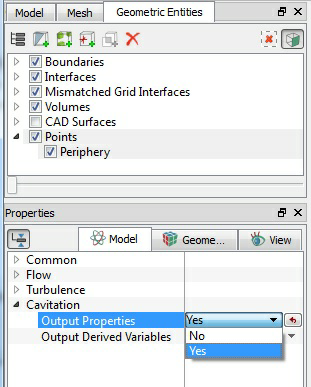
Figure 5.78 - Output activation for points-Property variables
Derived Variables
Derived Variables are engineering data computed from the Primary Variables. While not required as a part of the solution, they provide valuable information for analysis of the results. They can be displayed in the GUI Viewing Window for selected Geometric Entities as well as written to the ascii file Filename_points.txt (when activated). They can also be viewed as X-Y Plots for Point Probes.
A list of the Derived Variables for the Cavitation module is shown below:
| Cavitation Module Derived Variables | ||||||
|---|---|---|---|---|---|---|
| Label in GUI Derived Variables List | Label in GUI X-Y Plot Menu (At a Point) | Label in points.txt | Definition | Units | Display/Output Options | Relevant Cavitation Models |
| Gas Volume Fraction | Gas Volume Fraction | volFracGas_ | Local volume fraction of the NCG | - | At a Point and in the GUI Display Window | All |
| Vapor Volume Fraction | Vapor Volume Fraction | volFracVap_ | Local volume fraction of vapor | - | At a Point and in the GUI Display Window | All |
| Dissolved Gas Volume Fraction | Dissolved Gas Volume Fraction | volFracDGas_ | Local volume fraction of the Dissolved NCG | - | At a Point and in the GUI Display Window | Equilibrium Dissolved Gas, Dissolved Gas, Full Gas |
| Total Gas Volume Fraction | Total Gas Volume Fraction | volFracT_ | Local volume fraction of all gases | - | At a Point and in the GUI Display Window | All |
As shown in Figure 5.79, Derived Variables are automatically activated for output on selected Geometric Entities, including Boundaries, Derived Surfaces, Interfaces and/or Volumes, depending on the modules selected. For Point Probes, however, explicit activation is required.
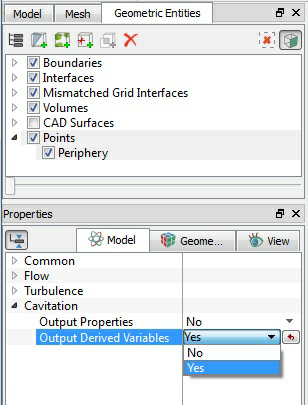
Figure 5.79 - Output activation for points-Derived variables
Integrated Quantities
An Integrated Output is the averaged or total value of a variable over a Boundary, Interface or Volume. When available and activated, the integrated quantities can be stored in the ascii file Filename_integrals.txt as well as be displayed in the GUI using X-Y Plots.
To access the variables listed below using expressions, the syntax given under Expressions column in Table 5.25 is used with a suffix “@boundary or volume name” such as allgasvol_pipe = cavitation.gas.v_t@pipe.
A table of the Integrated Quantities for the Cavitation module is shown below:
| Cavitation Module Integrated Quantities | |||||||
|---|---|---|---|---|---|---|---|
| Label in Properties Panel Output Choices | Label in GUI X-Y Plot Menu | Label in integral.txt | Definition | Units | Relevant Geometric Entity | Relevant Cavitation Models | Expression |
| Gas/Vapor Area (Fraction) | Gas Area | gas_area_ | Average Area Fraction on a Boundary | m2 | Boundary | All | cavitation.gas_area |
| Gas/Vapor Area (Fraction) | Vapor Area | vap_area_ | Average Vapor Fraction on a Boundary | m2 | Boundary | All | cavitation.vap_area |
| Gas/Vapor Area (Fraction) | Gas Area Fraction | gas_af_ | Area of the Free Gas on a Boundary | - | Boundary | All | cavitation.gas_af |
| Gas/Vapor Area (Fraction) | Vapor Area Fraction | vap_af_ | Area of the Vapor on a Boundary | - | Boundary | All | cavitation.vap_af |
| All Gas Volume | All Gas Volume | gas_v_t_ | Total volume of all gas (vapor, Dissolved NCG, and/or free NCG in a selected Volume) | m3 | Volumes | All | cavitation.gas_v_t |
| All Gas Volume Fraction | Total Gas Volume Fraction | gas_vf_t_ | Average volume fraction of all gases combined (vapor, Dissolved NCG, and free NCG) in a selected Volume | - | Volumes | All | cavitation.gas_vf_t |
| Gas Volume | Gas Volume | gas_v_ | Total volume of free NCG in a selected Volume | m3 | Volumes | All | cavitation.gas_v |
| Gas Volume Fraction | Gas Volume Fraction | gas_vf_ | Average volume fraction of free NCG in a selected Volume | - | Volumes | All | cavitation.gas_vf |
| Liquid Volume | Liquid Volume | liq_v_ | Total volume of Liquid in a selected Volume | m3 | Volumes | All | cavitation.liq_v |
| Liquid Volume Fraction | Liquid Volume Fraction | liq_vf_ | Average volume fraction of Liquid in a selected Volume | - | Volumes | All | cavitation.liq_vf |
| Vapor Volume | Vapor Volume | vap_v_ | Total volume of vapor in a selected Volume | m3 | Volumes | All | cavitation.vap_v |
| Vapor Volume Fraction | Vapor Volume Fraction | vap_vf_ | Average volume fraction of vapor in a selected Volume | - | Volumes | All | cavitation.vap_vf |
For a selected Geometric entity, the integrated outputs must be explicitly activated as shown in Figure 5.80.
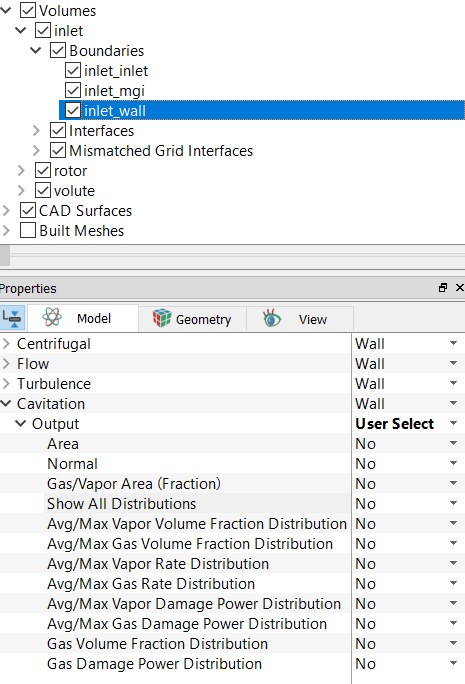
Figure 5.80 - Output activation-Integrated quantities
Avg/Max Vapor Volume Fraction Distribution
The Avg/Max Vapor Volume Fraction Distribution outputs are spatial distributions of "Time Average" or "Time Maximum" values of vapor volume fraction in boundaries:
- "Time Average" is the average values during a "Period" of time.
- "Time Maximum" is the maximum values encountered during a "Period" of time.
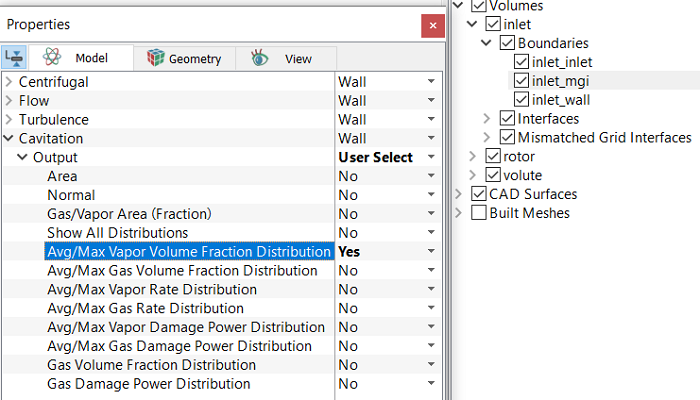
The "Period" is defined as number of time steps of a transient simulation. This “Period” is specified by the Cycle Computation Interval. The Avg/Max Vapor Volume Fraction Distribution output is activated for a selected boundary as follows:
- Click Common in the Model Panel.
- In Properties Panel > Model Tab, set Cycle Computation Interval, which is the number of time steps for the "Period" user wants to calculate time average, or find minimum and maximum values.
- Select Geometric Entities Panel > Boundaries > [Desired Boundary]
- Select Properties Panel > Model Tab > Cavitation > Output > User Select > Avg/Max Vapor Volume Fraction Distribution > Yes
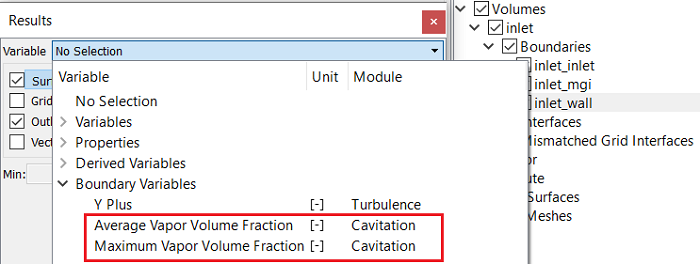
The added outputs are shown in the Results Panel under Variable > Boundary Variables as shown in Figure 5.82. They are plotted as contours on the selected boundary.
|
|
The Average and Maximum Vapor Volume Fraction Distributions on the boundary are stored in the files: Filename_boundary_ average_vapor_volume_fraction.txt and Filename_boundary_ max_vapor_volume_fraction.txt respectively. They are written at the same frequency as the result files are saved.
Avg/Max Gas Volume Fraction Distribution
The Avg/Max Gas Volume Fraction Distribution outputs are spatial distributions of "Time Average" or "Time Maximum" values of gas volume fraction in boundaries:
- "Time Average" is the average values during a "Period" of time.
- "Time Maximum" is the maximum values encountered during a "Period" of time.
The "Period" is defined as number of time steps of a transient simulation. This “Period” is specified by the Cycle Computation Interval. The Avg/Max Gas Volume Fraction Distribution output is activated for a selected boundary as follows:
- Click Common in the Model Panel.
- In Properties Panel > Model Tab, set Cycle Computation Interval, which is the number of time steps for the "Period" user wants to calculate time average, or find minimum and maximum values.
- Select Geometric Entities Panel > Boundaries > [Desired Boundary]
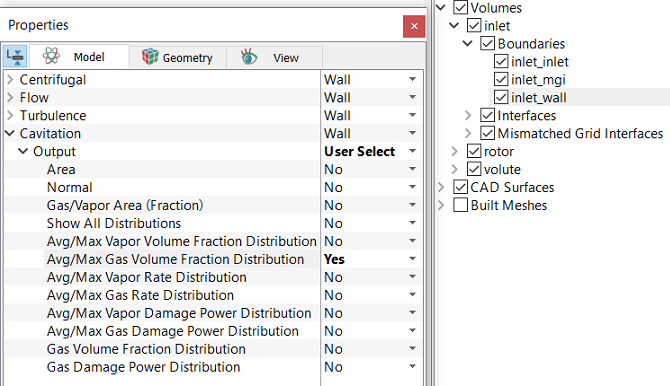
- Select Properties Panel > Model Tab > Cavitation > Output > User Select > Avg/Max Gas Volume Fraction Distribution > Yes
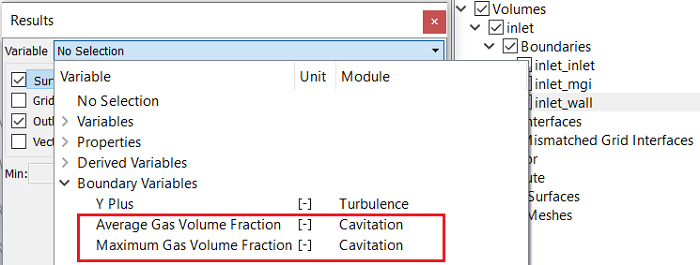
The added outputs are shown in the Results Panel under Variable > Boundary Variables as shown in Figure 5.84. They are plotted as contours on the selected boundary.
|
|
The Average and Maximum Gas Volume Fraction Distributions on the boundary are stored in the files: Filename_boundary_ average_gas_volume_fraction.txt and Filename_boundary_ max_gas_volume_fraction.txt respectively. They are written at the same frequency as the result files are saved.
Avg/Max Vapor Rate Distribution
The Avg/Max Vapor rate Distribution outputs are spatial distributions of "Time Average" or "Time Maximum" values of vapor volume rate in boundaries:
- "Time Average" is the average values during a "Period" of time.
- "Time Maximum" is the maximum values encountered during a "Period" of time.
The "Period" is defined as number of time steps of a transient simulation. This “Period” is specified by the Cycle Computation Interval. The Avg/Max Vapor rate Distribution output is activated for a selected boundary as follows:
- Click Common in the Model Panel.
- In Properties Panel > Model Tab, set Cycle Computation Interval, which is the number of time steps for the "Period" user wants to calculate time average, or find minimum and maximum values.
- Select Geometric Entities Panel > Boundaries > [Desired Boundary]
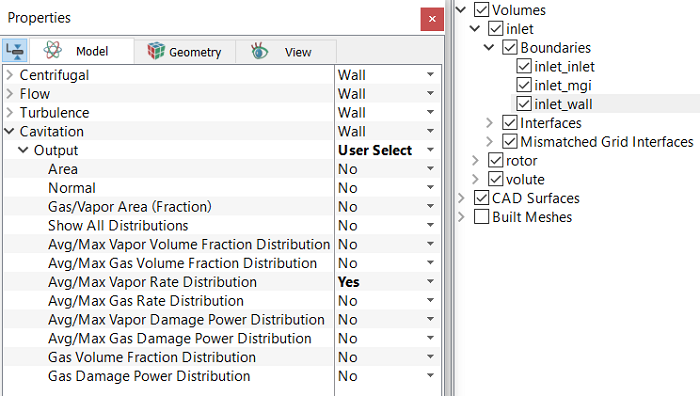
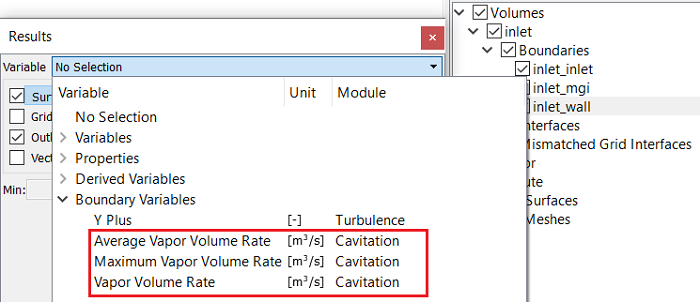
- Select Properties Panel > Model Tab > Cavitation > Output > User Select > Avg/Max Vapor rate Distribution > Yes
The added outputs are shown in the Results Panel under Variable > Boundary Variables as shown in Figure 5.86. They are plotted as contours on the selected boundary.
|
|
The Average and Maximum Vapor Volume rate Distributions on the boundary are stored in the files: Filename_boundary_ average_vapor_volume_rate.txt and Filename_boundary_ max_vapor_volume_rate.txt respectively. They are written at the same frequency as the result files are saved.
Avg/Max Gas Rate Distribution
The Avg/Max Gas rate Distribution outputs are spatial distributions of "Time Average" or "Time Maximum" values of gas volume rate in boundaries:
- "Time Average" is the average values during a "Period" of time.
- "Time Maximum" is the maximum values encountered during a "Period" of time.
The "Period" is defined as number of time steps of a transient simulation. This “Period” is specified by the Cycle Computation Interval. The Avg/Max Gas rate Distribution output is activated for a selected boundary as follows:
- Click Common in the Model Panel.
- In Properties Panel > Model Tab, set Cycle Computation Interval, which is the number of time steps for the "Period" user wants to calculate time average, or find minimum and maximum values.
- Select Geometric Entities Panel > Boundaries > [Desired Boundary]
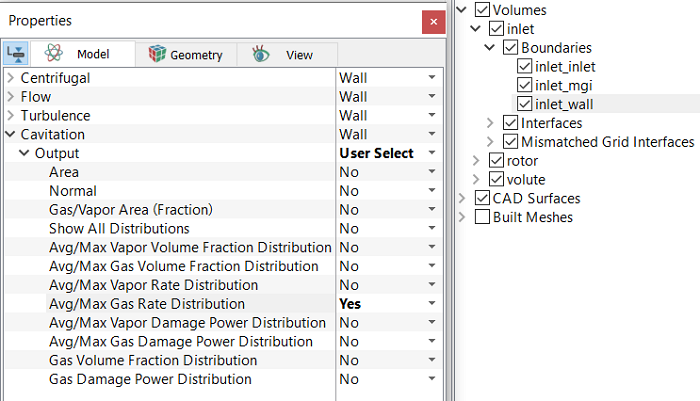
- Select Properties Panel > Model Tab > Cavitation > Output > User Select > Avg/Max Gas rate Distribution > Yes
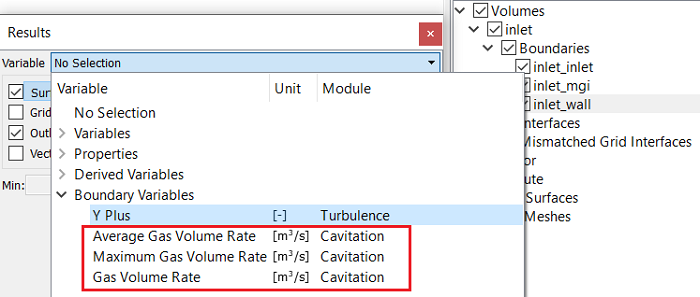
The added outputs are shown in the Results Panel under Variable > Boundary Variables as shown in Figure 5.88. They are plotted as contours on the selected boundary.
|
|
The Average and Maximum Gas Volume rate Distributions on the boundary are stored in the files: Filename_boundary_ average_gas_volume_rate.txt and Filename_boundary_ max_gas_volume_rate.txt respectively. They are written at the same frequency as the result files are saved.
Avg/Max Vapor Damage Power Distribution
The Avg/Max Vapor Damage Power Distribution outputs are spatial distributions of "Time Average" or "Time Maximum" values of Vapor damage power in boundaries:
- "Time Average" is the average values during a "Period" of time.
- "Time Maximum" is the maximum values encountered during a "Period" of time.
The "Period" is defined as number of time steps of a transient simulation. This “Period” is specified by the Cycle Computation Interval. The Avg/Max Vapor Damage Power Distribution output is activated for a selected boundary as follows:
- Click Common in the Model Panel.
- In Properties Panel > Model Tab, set Cycle Computation Interval, which is the number of time steps for the "Period" user wants to calculate time average, or find minimum and maximum values.
- Select Geometric Entities Panel > Boundaries > [Desired Boundary]
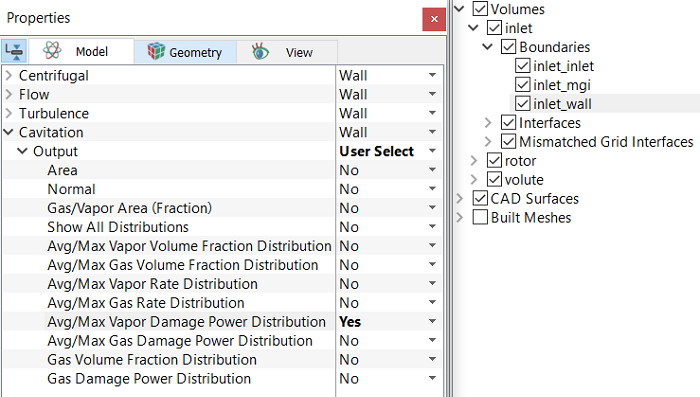
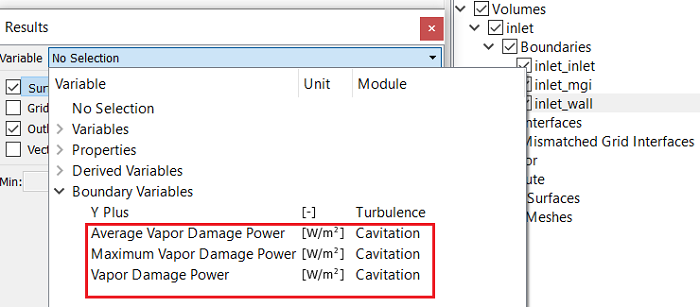
- Select Properties Panel > Model Tab > Cavitation > Output > User Select > Avg/Max Vapor Damage Power Distribution > Yes
The added outputs are shown in the Results Panel under Variable > Boundary Variables as shown in Figure 5.90. They are plotted as contours on the selected boundary.
|
|
The Average and Maximum Vapor Damage power Distributions on the boundary are stored in the files: Filename_boundary_ average_vapor_damage_power.txt and Filename_boundary_ max_vapor_damage_power.txt respectively. They are written at the same frequency as the result files are saved.
Avg/Max Gas Damage Power Distribution
The Avg/Max Gas Damage Power Distribution outputs are spatial distributions of "Time Average" or "Time Maximum" values of Gas damage power in boundaries:
- "Time Average" is the average values during a "Period" of time.
- "Time Maximum" is the maximum values encountered during a "Period" of time.
The "Period" is defined as number of time steps of a transient simulation. This “Period” is specified by the Cycle Computation Interval. The Avg/Max Gas Damage Power Distribution output is activated for a selected boundary as follows:
- Click Common in the Model Panel.
- In Properties Panel > Model Tab, set Cycle Computation Interval, which is the number of time steps for the "Period" user wants to calculate time average, or find minimum and maximum values.
- Select Geometric Entities Panel > Boundaries > [Desired Boundary]
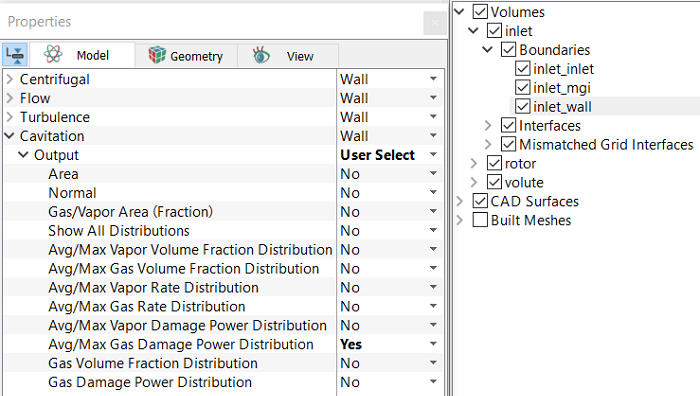
- Select Properties Panel > Model Tab > Cavitation > Output > User Select > Avg/Max Gas Damage Power Distribution > Yes
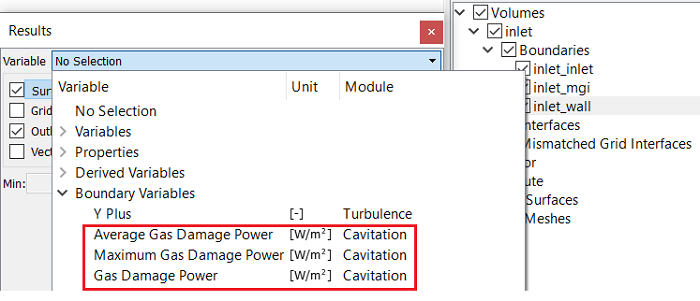
The added outputs are shown in the Results Panel under Variable > Boundary Variables as shown in Figure 5.92. They are plotted as contours on the selected boundary.
|
|
The Average and Maximum Gas Damage power Distributions on the boundary are stored in the files: Filename_boundary_ average_gas_damage_power.txt and Filename_boundary_ max_gas_damage_power.txt respectively. They are written at the same frequency as the result files are saved.
Show All Distributions
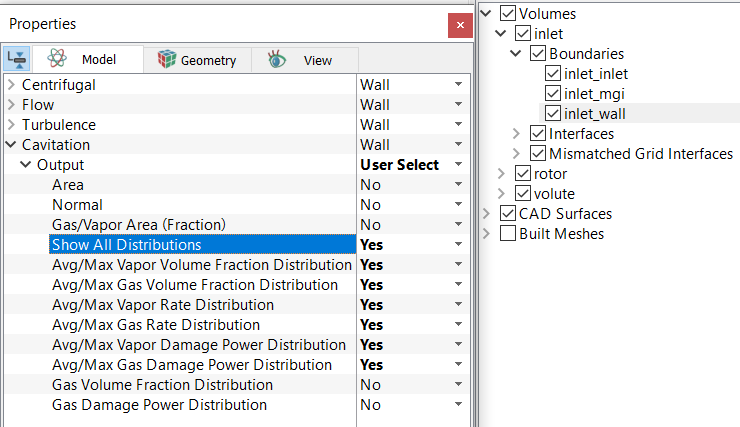
The Show All Distributions switches all the following outputs to Yes:
- Avg/Max Vapor Volume Fraction Distribution
- Avg/Max Gas Volume Fraction Distribution
- Avg/Max Vapor Rate Distribution
- Avg/Max Gas Rate Distribution
- Avg/Max Vapor Damage Power Distribution
- Avg/Max Gas Damage Power Distribution
Gas Volume Fraction Distribution
The total Gas Volume Fraction Distribution output is activated for a selected boundary under the Cavitation module as follows:
- Geometric Entities Panel > Boundaries > [Desired Boundary]
- Properties Panel > Model Tab > Cavitation > Output > User Select > Gas Volume Fraction Distribution > Yes
The Gas Volume Fraction Distribution for selected boundaries is output in a separate file: Filename_boundary_total_gas_volume_fraction.txt. The Total Gas Volume Fraction Distribution is output at the same frequency as the result files are saved.
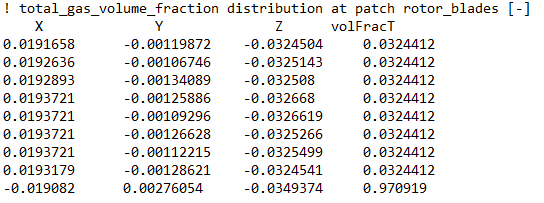
Figure 5.94 - Gas Volume Fraction Distribution Output file
Gas Damage Power Distribution
The total Gas Damage Power Distribution output is activated for a selected boundary under the Cavitation module as follows:
- Geometric Entities Panel > Boundaries > [Desired Boundary]
- Properties Panel > Model Tab > Cavitation > Output > User Select > Gas Damage Power Distribution > Yes
The Gas Damage Power Distribution for selected boundaries is output in a separate file: Filename_boundary_damage_power.txt. The Gas Damage Power Distribution is output at the same frequency as the result files are saved.
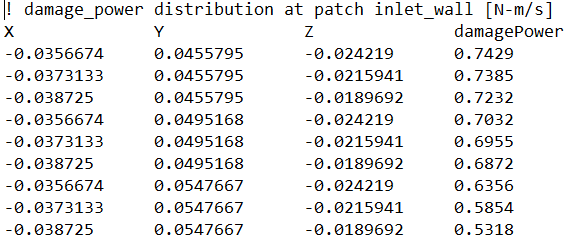
Figure 5.95 - Gas Damage Power Distribution Output file
|
Note:
|