5.2 Flow
The Flow module forms the core of the Simerics-MP solver. It provides comprehensive modelling capabilities for a wide range of flow problems, with different physical characteristics and complex geometries. The main features of the flow solver are outlined as follows:
- Flow module is a general-purpose, multi-dimensional, pressure-based, finite-volume solver for incompressible and compressible, laminar and turbulent fluid flows.
- Both steady-state and transient analyses can be performed for internal and external flows under single or multiple reference frames, using accurate temporal and spatial numerical schemes as well as allowing mismatched interfaces.
- A range of viscosity models are available for both Newtonian and Non-Newtonian flows.
- The state equations for density include constant, compressible liquid, ideal gas and isentropic gas.
- Various useful features are provided including porous media and lumped parameter on interfaces (fan, pressure jump and porous surface).
- A variety of conventional methods and one-dimensional models are adopted to determine flow boundary conditions: Inlet, outlet, interface, wall and symmetry.
- User-defined volume sources and boundary conditions using “Expression Editor”.
In this manual, some of the definitions for the Flow modules are listed. The theory of the basic fluid flow is first presented under Physics. It consists of the general governing equations, specific physical models adopted, and the boundary conditions. Under Conditions, the solver functionalities and work flow of the flow solver are described. Finally, the list of post-processing quantities is given in Output Variables.
|
To activate the Flow module:
|
Figure 5.6 - Flow Module |
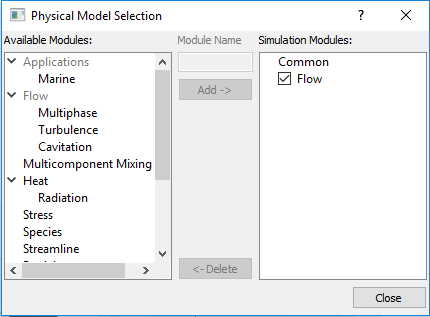
The module is explained as follows:
- Definitions: Terminologies relevant to the Flow module.
- Physics: Models, methods and constants used in the Flow module.
- Conditions: Specifying conditions for the entities-boundaries, interfaces, volumes under the Flow module.
- Output Variables: Outputs from the Flow module.
.