Material Property
|
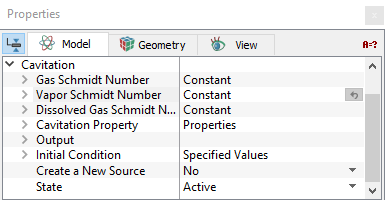
Material and model properties are volume conditions in the Cavitation module pertaining to selected Volumes. Specify the material properties as follows: |
Figure 5.70 - Material property |
Schimdt Numbers
The Schmidt Numbers: Gas Schmidt Number, Vapor Schmidt Number, and Dissolved Gas Schmidt Number are specified for each volume. They are set to a constant Value of 1 by default.
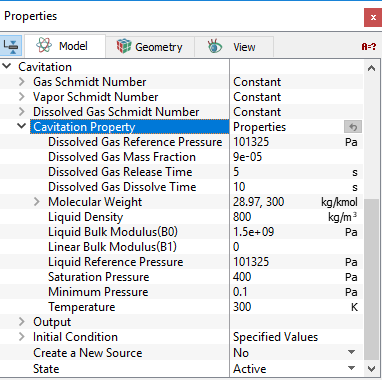
Cavitation PropertyThe parameters under Cavitation Property describe the physical properties of the NCG and the vapor in the mixture flow. They also pertain to the amounts and rates of formation, rates of absorption and/or release of the NCG and the vapor in the liquid. The following properties can be specified for a selected volume under Cavitation in the Model Panel: |
 Description
Gas Mass Fraction
This allows to specify the mass fraction of the Non-Dissolved (NCG) present in a selected volume.
This is available for a volume under the Constant Gas Model, Dissolved Gas Mass Fraction, and Equilibrium Dissolved Gas Model. For the Dissolved Gas Model, and Equilibrium Dissolved Gas Model, the value of the Gas Mass Fraction is used as the concentration of non-dissolved gas at the boundary. It does not restrict the value of the Gas Mass Fraction within the volume.
This is not available as a volume condition under the Full Gas Model and the Variable Gas Mass Fraction model, where the amount of Non-Dissolved NCG is computed as part of the solution.
Molecular Weight
For the NCG in the Cavitation module, specify the following:
- Gas Molecular Weight: The molecular weight of the NCG, which is required when using the ideal gas law to calculate the NCG density.
- Vapor Molecular Weight: The molecular weight for the vapor, which is required when using the ideal gas law to calculate the vapor density.
Liquid Density
The Liquid Density is the density of liquid component in cavitating flows. It can be a constant, compressible liquid, or user-defined function using the Expression Editor.
Liquid Bulk Modulus
The Liquid Bulk Modulus is the bulk modulus of liquid component of the fluid. The effective bulk modulus of the fluid (locally) is computed based on the Compressible Liquid model using the Liquid Bulk Modulus, Liquid Reference Pressure and Linear Bulk Modulus(B1). The Liquid Bulk Modulus of the fluid can be made a function using the Expression Editor.
Liquid Reference Pressure
This is used to compute the density based on the Compressible Liquid model.
Saturation Pressure
The saturation pressure is the vapor pressure at which the vapor and its liquid are at equilibrium. This is used as a threshold pressure to determine the evaporation and condensation process in cavitation. The saturation pressure is a material property that is strongly temperature dependent. For isothermal flows, it is a constant at the given temperature.
If temperature varies (i.e. the Heat module is active) the Saturation Pressure would have to be made a function of temperature using the Expression Editor to include temperature effects. The effective vapor density is computed as function of the local pressure and Saturation Pressure based on Boyle’s Law.
Minimum Pressure
In the cavitation models, a positive lower limit is imposed on the flow pressure (minimum pressure) to guarantee physical solutions as well as to enhance numerical stability.
Dissolved Gas Reference Pressure
This parameter is used to determine the equilibrium mass fraction of the dissolved gas at the local pressure in equation 5.236.
It is specified for selected volumes under the Cavitation module when the Equilibrium Dissolved Gas Model, Dissolved Gas Model or Full Gas Model is active.
Dissolved Gas Mass Fraction
This parameter is the mass fraction of the dissolved gas at the Dissolved Gas Reference Pressure and is used to determine the equilibrium mass fraction of the dissolved gas at the local pressure according to equation 5.236.
It is specified for selected volumes under the Cavitation module when the Equilibrium Dissolved Gas Model, Dissolved Gas Model or Full Gas Model is active.
Dissolved Gas Release Time
The Dissolved Gas Release Time,  (seconds) is a parameter that determines the rate at which NCG is released from solution based on equation 5.236.
This is specified for selected volumes under Cavitation Property when the Dissolved Gas Model and Full Gas Model is active.
Dissolved Gas Dissolve Time
The Dissolved Gas Dissolve Time,  (seconds) is a parameter that determines the rate at which NCG goes into solution based on equation 5.236.
This is specified for selected volumes under Cavitation Property when either the Dissolved Gas Model or Full Gas Model is active.